
CYSAT Madrid 2026: Building Secure and Resilient Space Capabilities for Spain and Europe
The first Spanish CYSAT brings operators, industry and agencies together as Europe seeks secure connectivity and Spain turns space ambitions into strategic responsibility.

A conference with a strategic purpose
On 28 October 2026, CYSAT, the leading conference on space cybersecurity, holds its first Spanish edition at Digitaliza Madrid and inaugurates Madrid Tech Week. Organised by the Comunidad de Madrid, the second edition of Madrid Tech Week runs from 28 October to 5 November 2026 and brings together more than 1,200 companies and 600 experts on seven stages, from space cybersecurity and digital assets to advanced manufacturing.
After the success of CYSAT Paris and CYSAT Asia in Singapore, CYSAT Madrid brings the Iberian space and cybersecurity community together with the global ecosystem.
The full-day programme is built around four pillars: strategy, governance and space defence; secure connectivity and critical orbital infrastructure; cyber resilience of space systems; and the new security paradigms and emerging technologies that will shape space sovereignty over the next decade.
Two stages share the venue. The Main Stage hosts keynotes and high-level panels on policy, investment and operational threats. The Technical Stage offers deep dives and practical sessions for those who build and defend orbital systems.
The agenda connects the Spanish Space Agency (AEE), the European Space Agency (ESA), satellite operators, defence companies, cybersecurity specialists and researchers.
Who is in the room
CYSAT Madrid brings together every link in the space security chain: the institutions that set the rules, the companies that build and operate satellites, the firms that attack and defend them, and the researchers working on tomorrow's protections. Few events put all of them in the same room.
The organisations on the programme, at a glance:
Rule-makers:
AEE (Spanish Space Agency) — Coordinates Spain’s space policy and represents the country at ESA
TEDAE — Represents Spain’s defence, security, aeronautics and space industry
ESA — Protects missions and infrastructure for 23 member states
Space ISAC — International hub for sharing threat intelligence on space systems
Builders and operators:
Hispasat — Spanish satellite operator taking part in IRIS²
Thales Alenia Space — Satellite manufacturer leading the Spanish GEO QKD project
Indra Space — Develops ground segment and space surveillance systems
GMV — Leader in satellite control centres, with its own cybersecurity division
Airbus — Builds satellites and secure communications systems
Sener — Designs and builds critical space subsystems and instruments
Security specialists:
HWG Sababa — Cyber threat intelligence and managed security services
IOActive — Security research into SATCOM and hardware
Integrasys — Satellite signal monitoring and interference detection
Oesía Group — Cryptographic products for space and defence
Sopra Steria — Cybersecurity, data protection and governance consulting
DamoTech — Florence-based developer of space security products
CYSEC — Creator of CYSAT; secure software for space systems
Researchers and educators:
IMDEA Software Institute — Research in cryptography and secure software
Vigo Quantum Communication Center — Research in satellite-based quantum communications
i2CAT — Research in quantum communications and secure satellite links
Woxsen University — AI research, including autonomous cyber defence
Universidad Politécnica de Madrid — Trains the engineers the space sector depends on
SPSIN — Introduces secondary-school students to aerospace
A detailed look at all the speakers is available on the CYSAT Madrid speakers page.
CYSAT Madrid is co-organised by CYSEC, together with the Agencia de Ciberseguridad de la Comunidad de Madrid, THE SIGN and RCC.Advisory. The Agencia, founding partner of the event, is also the hosting partner. The AEE (Agencia Espacial Española) and TEDAE, the Spanish association of defence, security, aeronautics and space technology companies, are supporting partners. The event is also supported by GMV, Hispasat, Indra Space, Integrasys, HWG Sababa, DamoTech and Space ISAC.
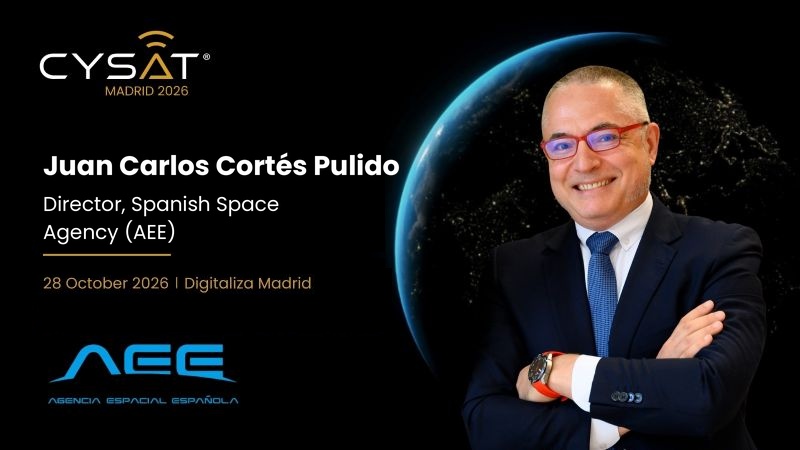
Alejandro Las Heras, for the host agency, and Alberto Gutiérrez, president of TEDAE, give the opening addresses. Juan Carlos Cortés, director of the AEE, delivers the Spanish Space Agency keynote in the late afternoon, and Miguel López-Valverde Argüeso, Madrid's regional minister for Digitalisation, closes the conference programme.
The question running through the programme is practical: who can keep essential services working when the infrastructure carrying them becomes a target?
Policy catches up with the threat
Spain's 2025 National Aerospace Security Strategy treats cybersecurity as part of the diagnosis of European vulnerabilities, not an optional technical addition, and calls for stronger protection of critical services. The AEE, attached to both the science and defence ministries, is defining how Spain applies cybersecurity by design and the EU's NIS2 framework to the space sector.
Hispasat and Indra: sovereignty reaches the ground
Hispasat CTO Manuel Sansegundo’s presentation “IRIS²: Sovereign, Secure Communications for Europe” places the operator at the centre of this discussion. EUSPA describes IRIS² as a multi-orbit system intended to serve governmental users alongside businesses and citizens, including crisis management and critical-infrastructure communications. These are planned capabilities, not a service already fully deployed.
Spain's stake is more specific than participation in a European flagship. In an August 2026 announcement, Hispasat said it would be prime contractor for the constellation's ground segment, including antennas, control systems and connections to terrestrial networks. It also identified itself as part of Indra Group. That responsibility makes Spanish industry relevant to the infrastructure through which the wider system will be managed and used.
ESA's part is technical rather than commercial. ESA describes itself as the technical backbone, industrial orchestrator and oversight authority of IRIS². Under the 2023 Contribution Agreement with the European Commission, it oversees the development, qualification and in-orbit validation of the constellation, and its December 2024 Partnership Project contract with the SpaceRISE consortium (SES, Eutelsat and Hispasat) has ESA monitor that work. The programme has moved on quickly this year. On 7 August 2026 the Commission and SpaceRISE signed an implementation agreement that adds 66 high-low Earth orbit satellites, bringing the main constellation to 348, with first launches targeted for 2029. In September ESA signed 18 contracts with around 80 industrial partners to mature Low-LEO concepts, resilient links and quantum-resistant cryptographic payloads. ESA brings the view of an organisation that protects missions and infrastructure for 23 member states, and Massimo Mercati, Head of its Security Office, opens the keynote programme at 10:00 with "Securing Space Systems in the Age of AI".
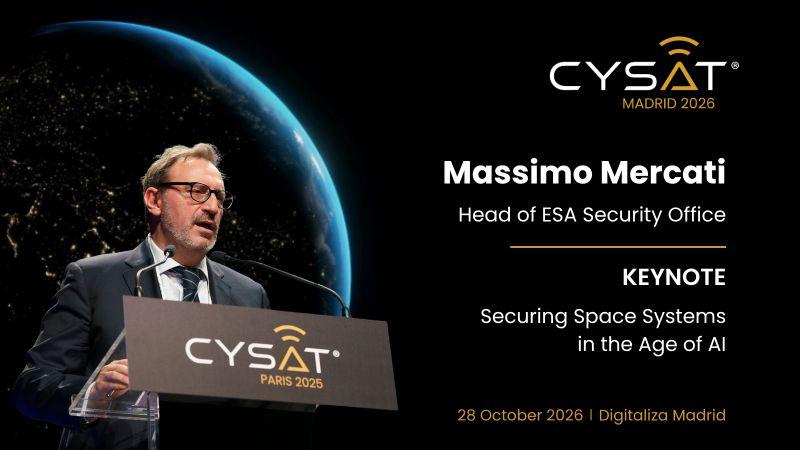
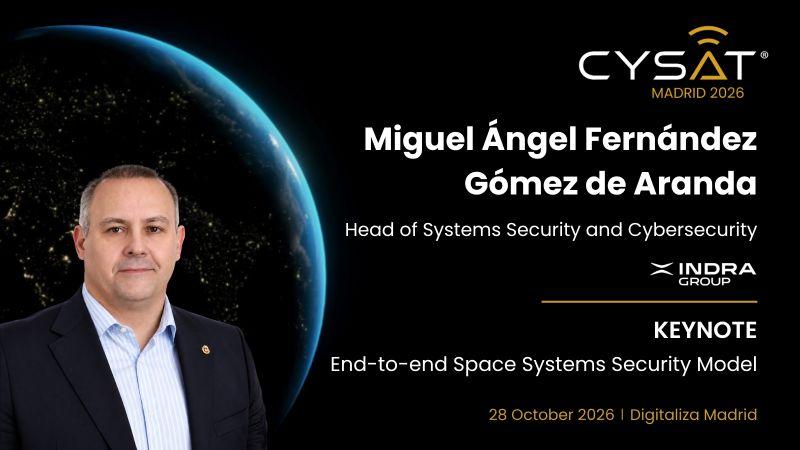
Indra Space's contribution, an "End-to-end Space Systems Security Model" presented by Miguel Ángel Fernández Gómez de Aranda, its Head of Systems Security and Cybersecurity, fits this setting. Indra develops ground segment and space surveillance systems, and the strategic lesson is that sovereignty cannot be measured by satellites alone.
Control centres, network connections and the organisations operating them belong in the same security discussion.
GMV and Integrasys: defending the service
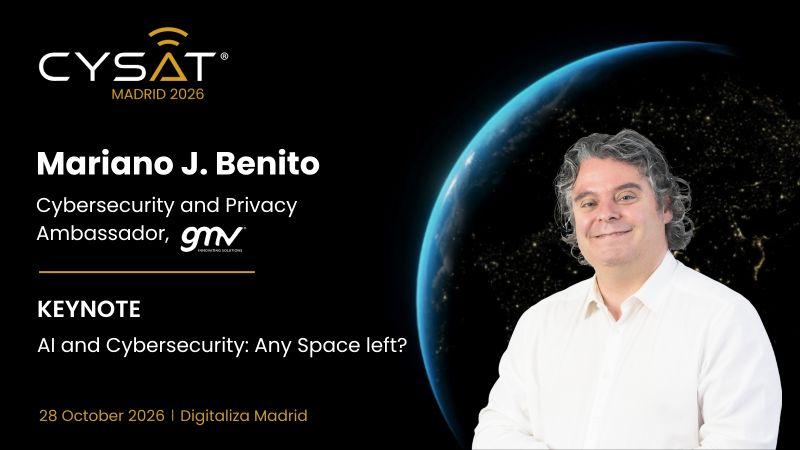
GMV, a world leader in satellite control centres and ground systems, with its own cybersecurity division, appears three times on the Main Stage and the Technical Stage programme. Mariano J. Benito, its Cybersecurity and Privacy Ambassador, asks “AI and Cybersecurity: Any Space Left?” at 15:30.
Miguel Ángel Molina Cobos, Chairman of GMV’s Space Council, sits on the ground-control panel, and Silvia Calle Cruces, a regulatory compliance consultant at GMV, joins the workforce panel.
Together with Massimo Mercati's session on securing space systems in the age of AI, these talks put artificial intelligence inside the security debate.
Integrasys adds a complementary perspective. Pedro Ruiz, its Customer Success and R&D Director, gives the afternoon keynote at 15:00 on “Protecting the Entry Door of Critical Communications: The Role of the Physical Layer in Cybersecurity”. The company specialises in satellite signal monitoring, and its published defence portfolio includes interference detection, mitigation and geolocation. This matters because the continuity of a satellite service depends on its radio links as well as its software.
The Technical Stage: keys, links and quantum engineering
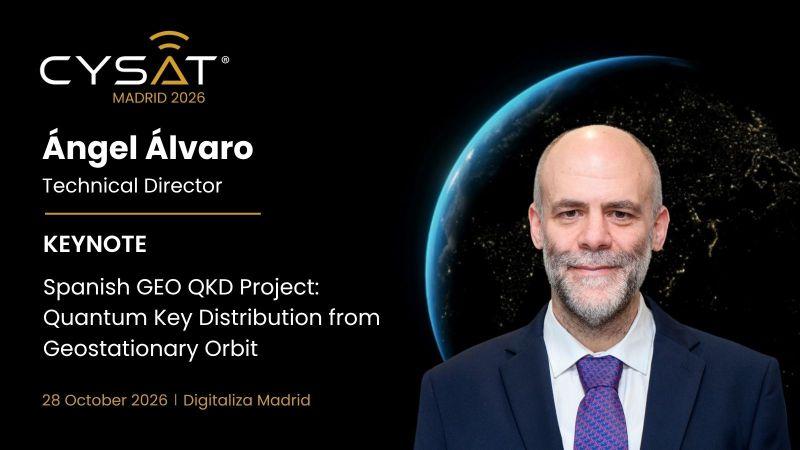
Ángel Álvaro Sánchez, Technical Director of the Spanish GEO QKD project at Thales Alenia Space Spain, presents it on the Main Stage at 12:00. There is a Spanish industrial programme behind that item. In January 2025, Thales Alenia Space and Hispasat announced the development and validation phase of a prototype for quantum key distribution from geostationary orbit. Thales Alenia Space in Spain leads the industrial consortium, with Hispasat responsible for mission design and the business plan. The project links Spanish public support and European recovery funding to a possible contribution to Europe's quantum communications infrastructure.
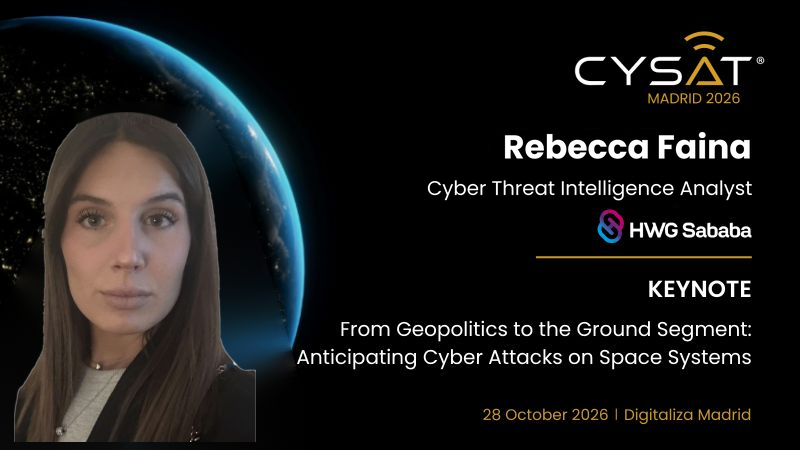
The Technical Stage shows where that kind of promise meets engineering reality, and its sessions read like a map of the attack surface. It opens with Rebecca Faina, Cyber Threat Intelligence Analyst at HWG Sababa, who connects geopolitics to the ground segment by anticipating cyber attacks on space systems.
IOActive's Director of Hardware Security, Gabriel González, is scheduled to show how leaking a single private key could compromise an entire SATCOM network.
Alin Petru Roșu of the IMDEA Software Institute rethinks PKI certificates for the post-quantum era.
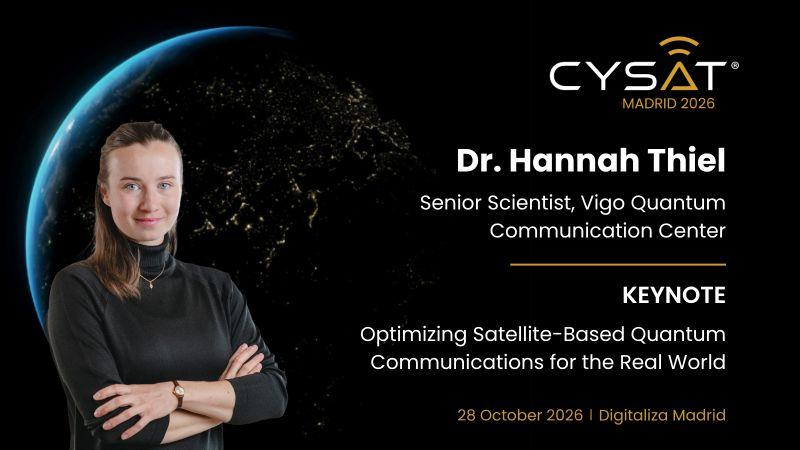
Dr Hannah Thiel of the Vigo Quantum Communication Center addresses what it takes to optimise satellite-based quantum communications for real-world conditions, and i2CAT's Alfonso Egio follows with memory-safe, post-quantum authentication for QKD links over lossy channels.
Dr Hemachandran K, Director of the AI Research Centre and Vice Dean of the School of Business at Woxsen University, presents autonomous cyber defence with AI agents, and the workforce panel closes the stage.
The analytical point is the chain, not any single link. A quantum key is only as strong as the authentication protecting it, the certificate infrastructure vouching for it and the ground network receiving it.
The agenda covers each layer.
The harder question is integration: will these technologies arrive as one maintainable system, or remain isolated demonstrations?
Cooperation must produce operational results
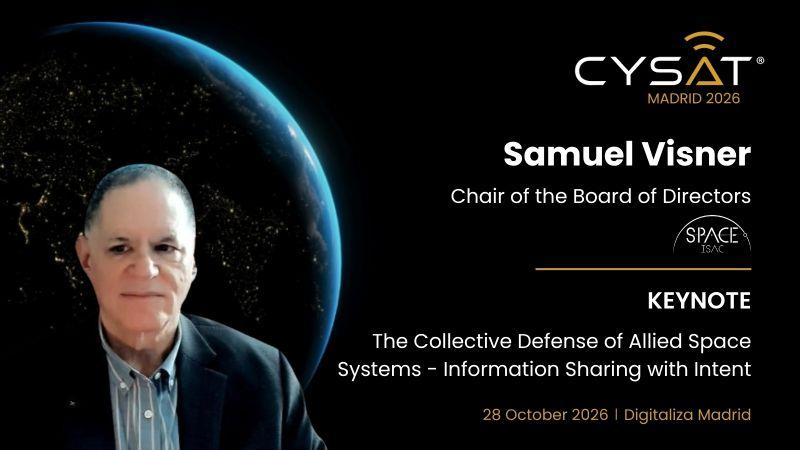
CYSAT Madrid's value will depend on what participants carry beyond the venue. Space ISAC is the international hub where operators, manufacturers and governments share threat intelligence on space systems. Its Board Chair, Samuel Visner, presents “The Collective Defense of Allied Space Systems: Information Sharing with Intent” at 10:30, which puts cooperation on the agenda.
The sharpest question may come from Panel "When Ground Control Is Compromised: Who Is Responsible for Saving the Mission?" Ángel López Zaballos (TEDAE/Airbus) moderates, with Miguel Ángel Molina Cobos (GMV), Luigi Martino (DamoTech) and César de la Serna (Sener) as panellists. Their companies span manufacturing, operations and services, which is where responsibility tends to blur. When a control centre is compromised, the operator, the prime contractor and the agency may each assume another will act.
A separate workforce panel on the Technical Stage, "Building Europe's Space Cyber Workforce: Are We Preparing for the Next Decade?", brings together SPSIN's Pablo Asenjo as moderator, Universidad Politécnica de Madrid's Víctor A. Villagrá, CYSEC CEO Patrick Trinkler and GMV's Silvia Calle Cruces.
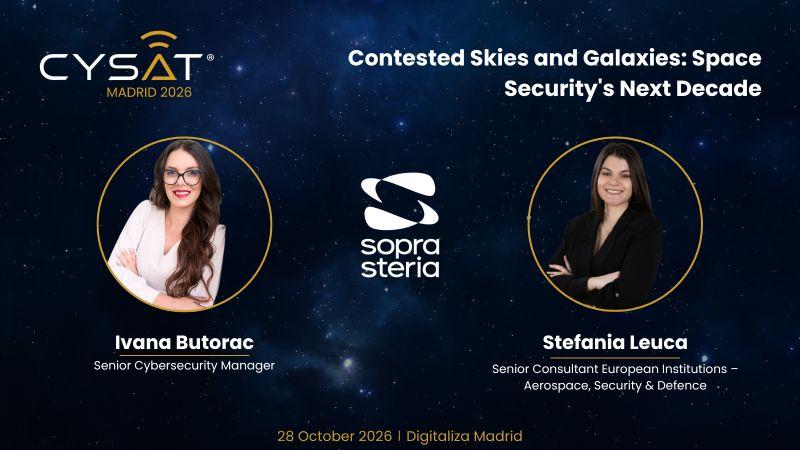
Those contributions connect industrial capability with the people and relationships needed to sustain it. The day's last conference session on the Main Stage looks further ahead: Sopra Steria's Stefania Leuca and Ivana Butorac discuss "Contested Skies and Galaxies: Space Security's Next Decade" at 17:00.
Conclusion:
Spain is well placed to contribute to shaping Europe’s space-security requirements, building on its industrial strengths and its growing role in European programmes. A single conference is one step in that effort, and its value will lie in what it sets in motion: stronger exchange of threat information, clearer shared responsibilities, realistic testing and a closer link between research and operations.
CYSAT Madrid 2026 is the first edition of the top international space cybersecurity event in Spain, with the ambition of establishing a regular CYSAT chapter in Spain and Iberia that shapes the European and global space cybersecurity landscape, carrying the sovereignty conversation from principle into practical cooperation.
Author: Tatiana Skydan, co-founder and editor-in-chief at THE SIGN