
Counting the sky: how launch numbers define space cyber risk
Space set a record in 2025 with 324 orbital launch attempts, and more than 43,000 satellites are expected to launch by 2035. Read analytical note by THE SIGN through a cybersecurity lens - the same numbers describe a fast-growing attack surface.
We count now because the year is nearly over and its direction is clear. Launches flattened in 2026, with 277 attempts by 26 November against 286 a year earlier, yet one operator holds about two thirds of active satellites. That concentration, more than the launch total, is what changes cyber risk.
2027 will test it. The EU Space Act, IRIS² and the Ariane 6 cadence will all be argued on these figures, so we say which count we use and where the sources differ.
1. The numbers
2025: a record year
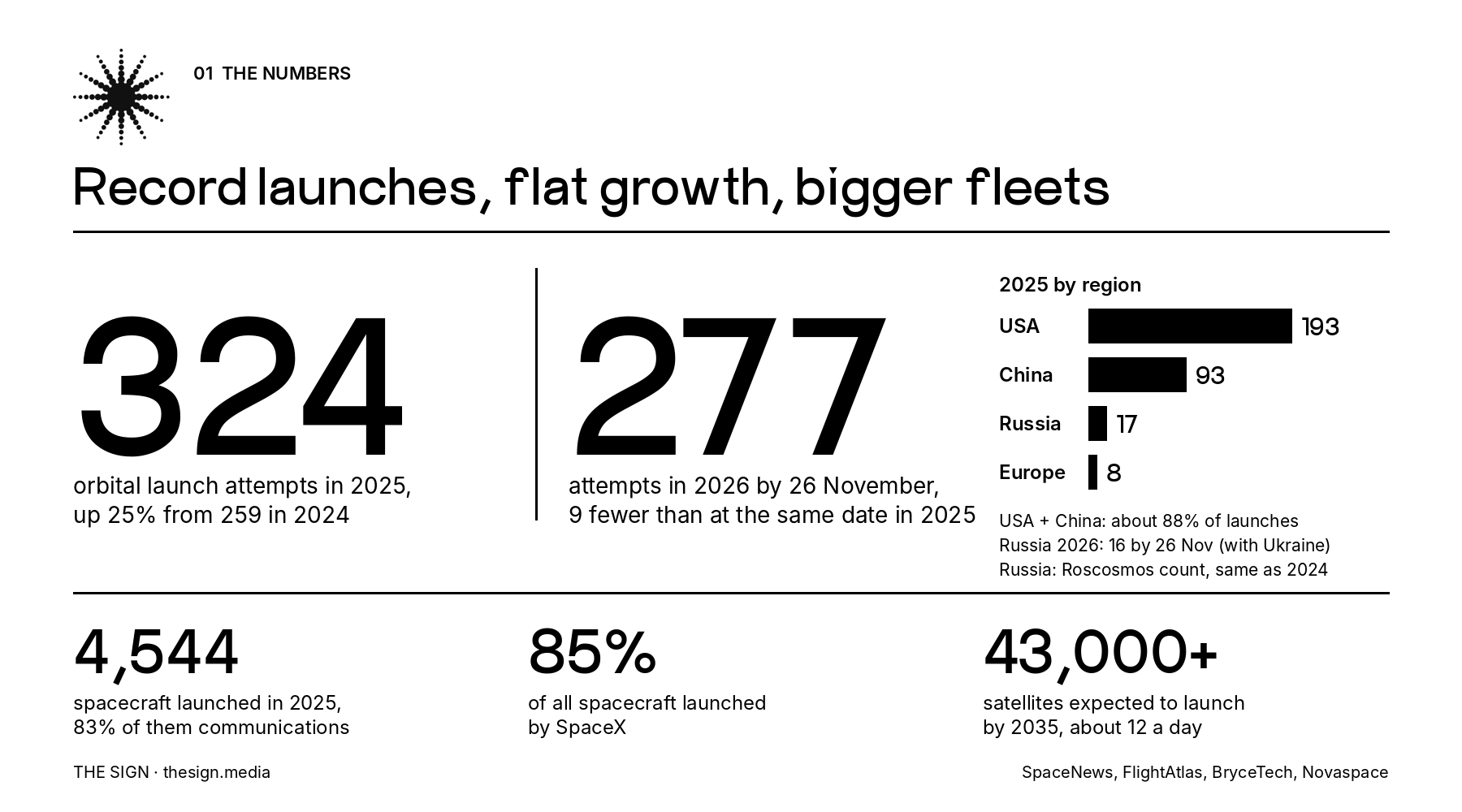
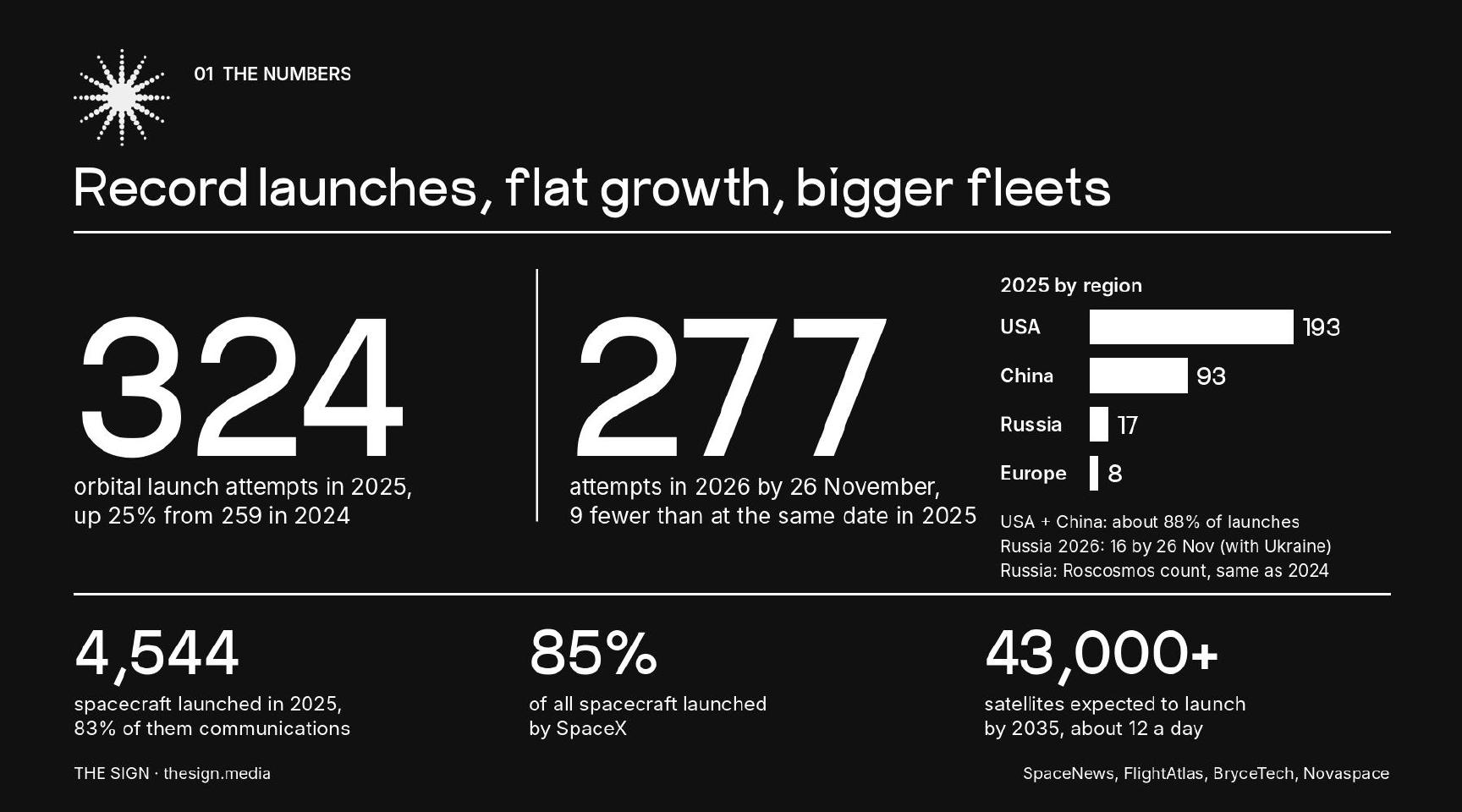
Orbital launch attempts reached 324 in 2025, up 25% from 259 in 2024, according to a SpaceNews analysis. The year also saw 4,544 spacecraft launched, 83% of them communications satellites, and SpaceX launched 85% of all spacecraft (BryceTech).
US providers made 193 launches, 59% of the total, and China made 93. Together that is about 88% of global activity (our arithmetic: 286 of 324). Europe made 8, up from 3 in 2024, which restored its access to space according to a European Space Agency report (gasworld). Looking ahead, Novaspace expects more than 43,000 satellites to launch by 2035, about 12 a day on average.
2026 so far
Launch growth has paused while constellations keep expanding. FlightAtlas counts 277 orbital launch attempts as of 26 November, nine fewer than at the same date in 2025 (FlightAtlas), with 7 failures and 1 partial failure (FlightAtlas log). SpaceX made 130 of them (47%, our arithmetic), other US providers 30, China 84, Russia and Ukraine together 16, Europe 8, India 4 and the rest of the world 5.
The constellations tell a different story. Starlink had 9,810 active satellites on 18 November, out of 13,024 launched since 2019 (Orbital Radar). By CelesTrak's count, 11,160 of the 16,822 active satellites on 27 October were Starlink, about two thirds (GCN). Amazon Leo had placed 396 production satellites in orbit by 8 November (Orbital Radar).
China has made 84 launches against a reported target of about 140 for 2026 (CislunarSpace). Its Qianfan constellation reached 200 satellites in orbit in June, ahead of Guowang's 168, and both aim for more than 10,000 (ISS Tracker).
Europe made eight launches, level with 2025. The first Ariane 64 flew on 12 February with 32 Amazon Leo satellites (CNES), and Isar Aerospace's Spectrum reached orbit on its second flight on 5 September (European Spaceflight). On 23 September, EU Commissioner Andrius Kubilius said European institutional missions will need 14 Ariane 6 launches a year by 2031 (Satnews).
Russia in the numbers
Roscosmos made 17 launches in 2025, the same as in 2024 and fewer than the 20 or more it had planned. Outside the pandemic years, that is the lowest level since 1961 (United24 Media). Roscosmos puts it at about 5% of 317 launches worldwide, third place behind the US and China (Prensa Latina).
For 2026, FlightAtlas counts 16 launches for Russia and Ukraine combined by 26 November. The GCAT catalogue showed 10 Russian launches, all successful, on 20 July (KeepTrack). Roscosmos says about 60 satellites were launched this year, taking the Russian constellation to almost 400 (Interfax).
These figures come from different sources and rules. Roscosmos reports its own launches and a global total of 317, while this note uses 324. FlightAtlas groups Russia with Ukraine, and GCAT assigns launches by the country of the pad and has data only to July. We therefore do not compare 2025 and 2026 directly. The 2026 pace looks close to 2025 but cannot be confirmed from these sources.
After the ICEYE case, launch counts miss a second side of Russia's activity: what its satellites do once they are in orbit. Russia launched a group of military Kosmos satellites on one Soyuz in April 2026, and in late May four of them moved into the orbital plane of ICEYE-X36, a commercial radar satellite believed to supply imagery to Ukraine (RUSI). Between 15 and 19 October, Kosmos 2612 made a deliberate series of approaches and came within about 500 metres, according to LeoLabs (Breaking Defense). One tracker puts the minimum at 26 metres, a figure other sources have not confirmed (Tech Times).
The consequences so far are practical. ICEYE's chief executive said the company moved its satellite in response, which appeared to prompt further Russian manoeuvres (Al Jazeera). The satellite stays in service, and Tech Times reports that Kosmos 2611 and 2613 were drifting toward the orbit of ICEYE-X37 in early November. The same report quotes a US Under Secretary of State calling the conduct consistent with weapons operations in orbit, and an analyst at Integrity ISR calling it a rehearsal for an attack. CSIS's Clayton Swope reads it as a test of whether the West reacts before Russia escalates (Tech Times).
For operators, RUSI judges that jamming or intercepting the data downlink is the likeliest aim, and that destroying the satellite is unlikely for now. ICEYE-X36 weighs under 100 kg and probably has no onboard defences or spare fuel to dodge, so its protection rests on redundancy across the wider constellation. RUSI also argues that commercial satellites supporting Ukraine can no longer be treated as safe, which matters for NATO because it uses ICEYE data. No binding rule says how close is too close, and as of 5 November Tech Times found no NATO statement and no new sanctions tied to the incident.
Our reading: proximity turns the radio link and the ground segment into the likely targets, and it makes a small commercial satellite without defences the weak point of a larger system.
Launch counts no longer tell the whole story (our reading). They flattened in 2026, yet one operator holds about two thirds of active satellites. For cyber risk, that concentration matters more than launch totals.
2. Why it matters for space cybersecurity
The five points below are our reading of the data.
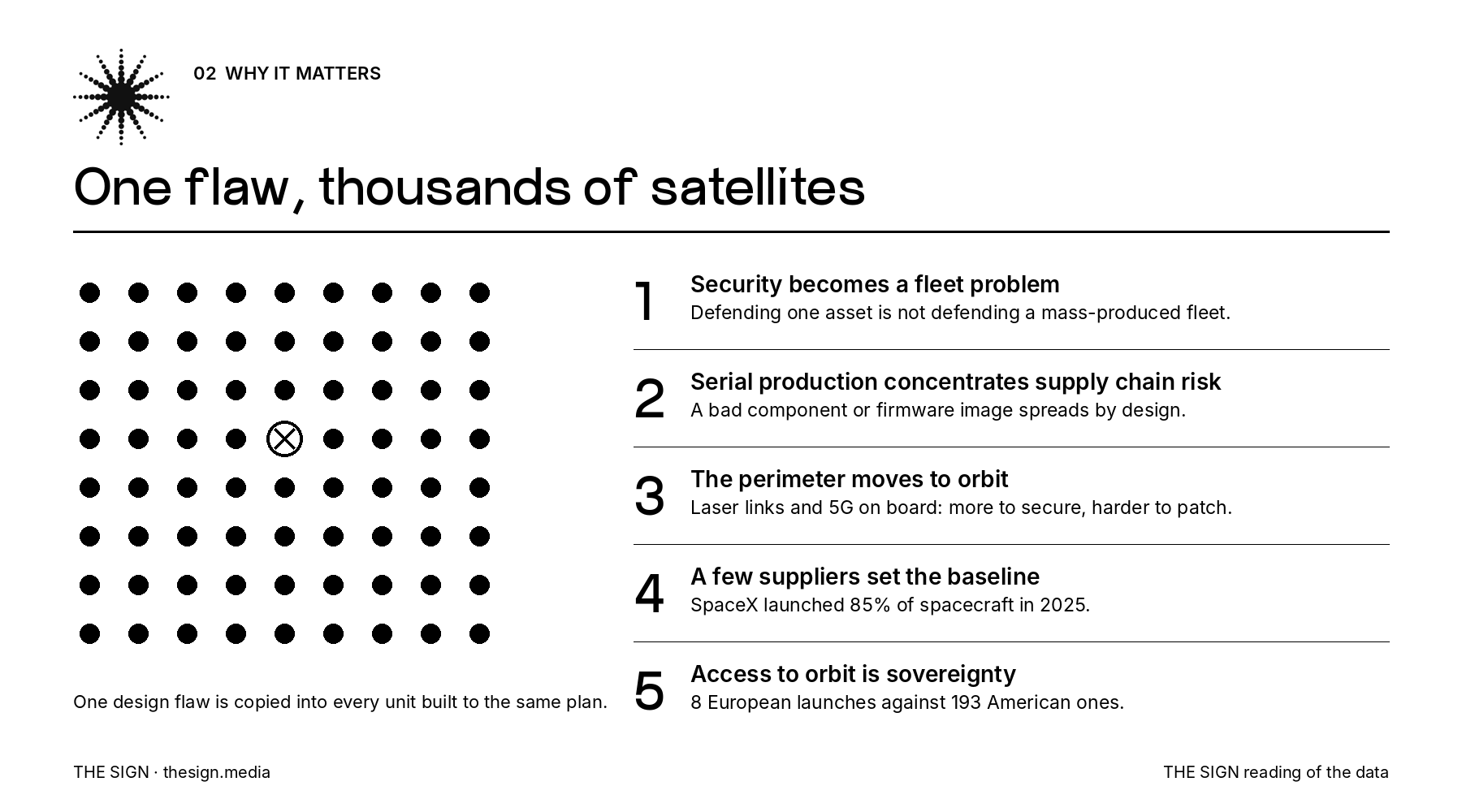
- Security becomes a fleet problem. When growth comes from constellations, one design flaw can exist in thousands of satellites at once. Defending a single high-value asset and defending a mass-produced fleet are different jobs.
- Serial production concentrates supply chain risk. Constellations favour standardised platforms and fast, automated production. That is efficient, and it means a compromised component, firmware image or toolchain spreads by design.
- The perimeter moves to orbit. New constellations such as Rassvet use inter-satellite laser links and 5G direct connectivity (Janes). More functions on the spacecraft mean more to secure, and patching and forensics get harder after launch.
- A few suppliers set the baseline. SpaceX launched 85% of all spacecraft in 2025 (BryceTech). When capacity is this concentrated, one vendor's security posture shapes risk for a large share of the sector.
- Access to orbit is a question of sovereignty. Eight European launches against 193 American ones show how dependent Europe is on others for access to orbit, and security requirements travel along that dependency.
3. Launches without notice
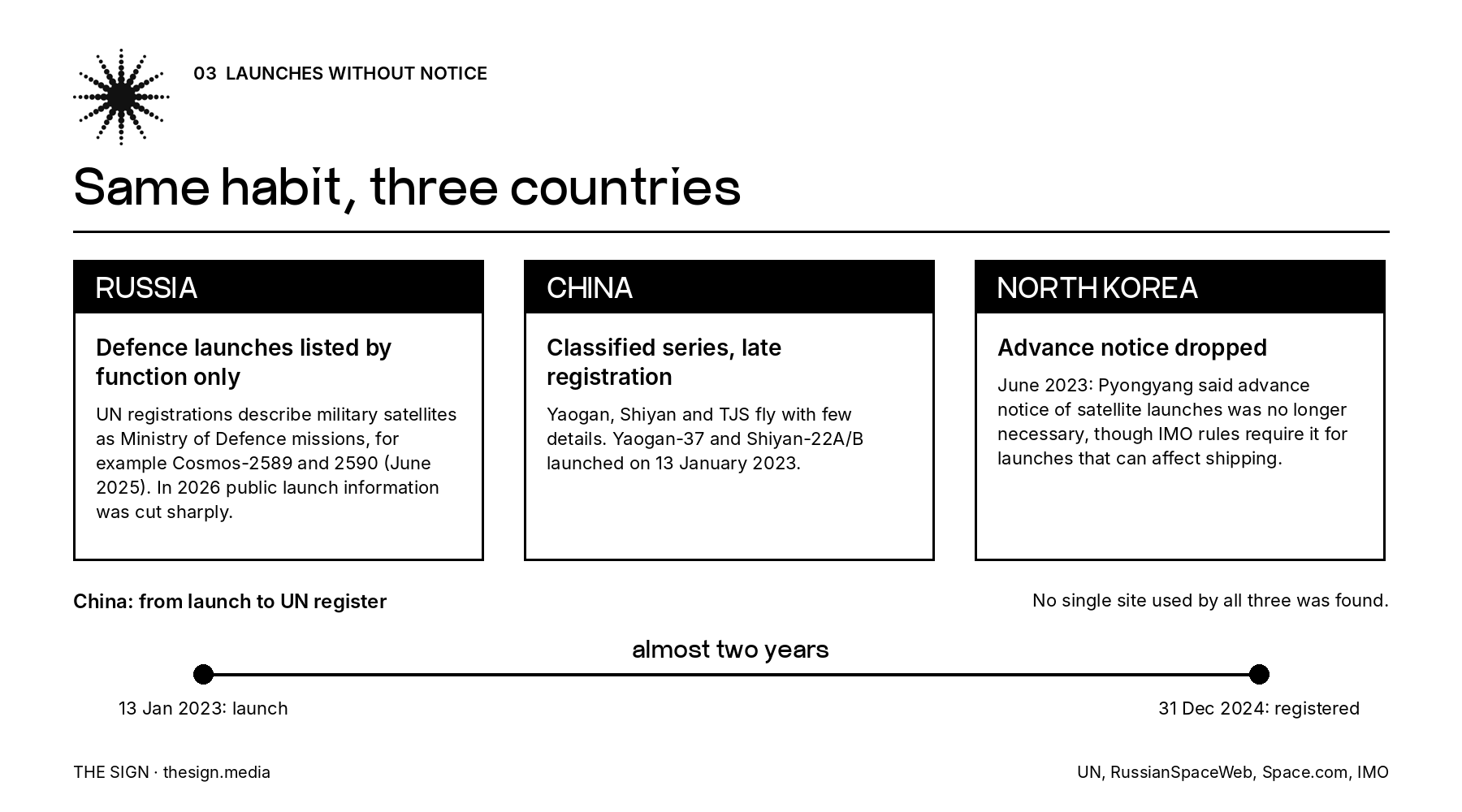
Russia, China and North Korea do not share one launch site, but they share a habit: military payloads go up with little public information.
Russia's UN registrations still list its military satellites, but only by function, as missions for the Ministry of Defence (for example Cosmos-2589 and Cosmos-2590, launched in June 2025) (UN). RussianSpaceWeb reports that in 2026 Roscosmos and the Defence Ministry sharply cut public information on launches, down to launch times, and that Russia announced it would stop reporting defence-related launches to the UN (RussianSpaceWeb).
China launches classified series such as Yaogan, Shiyan and TJS with few or no details of what they do (Space.com). Yaogan-37 and Shiyan-22A and 22B, launched on 13 January 2023, were entered in the UN register on 31 December 2024, almost two years later, and described only as test satellites (UN document ST/SG/SER.E/1237).
North Korea went further. In June 2023, after the IMO condemned its launch, Pyongyang said advance notice of satellite launches was no longer necessary (Bloomberg via BNN). The IMO says that as a member North Korea must give prior notice of launches that could affect shipping (Korea Herald via Asia News Network). In an earlier case the ITU said the information provided was not enough to register a satellite in its frequency register (NBC New York).
Why it matters (our reading): an object with an unknown owner, function and orbit is harder to track, attribute and assess for cyber risk. Less reporting also means less shared data for the space situational awareness that defenders rely on.
4. Nuclear context: the orbit these constellations depend on
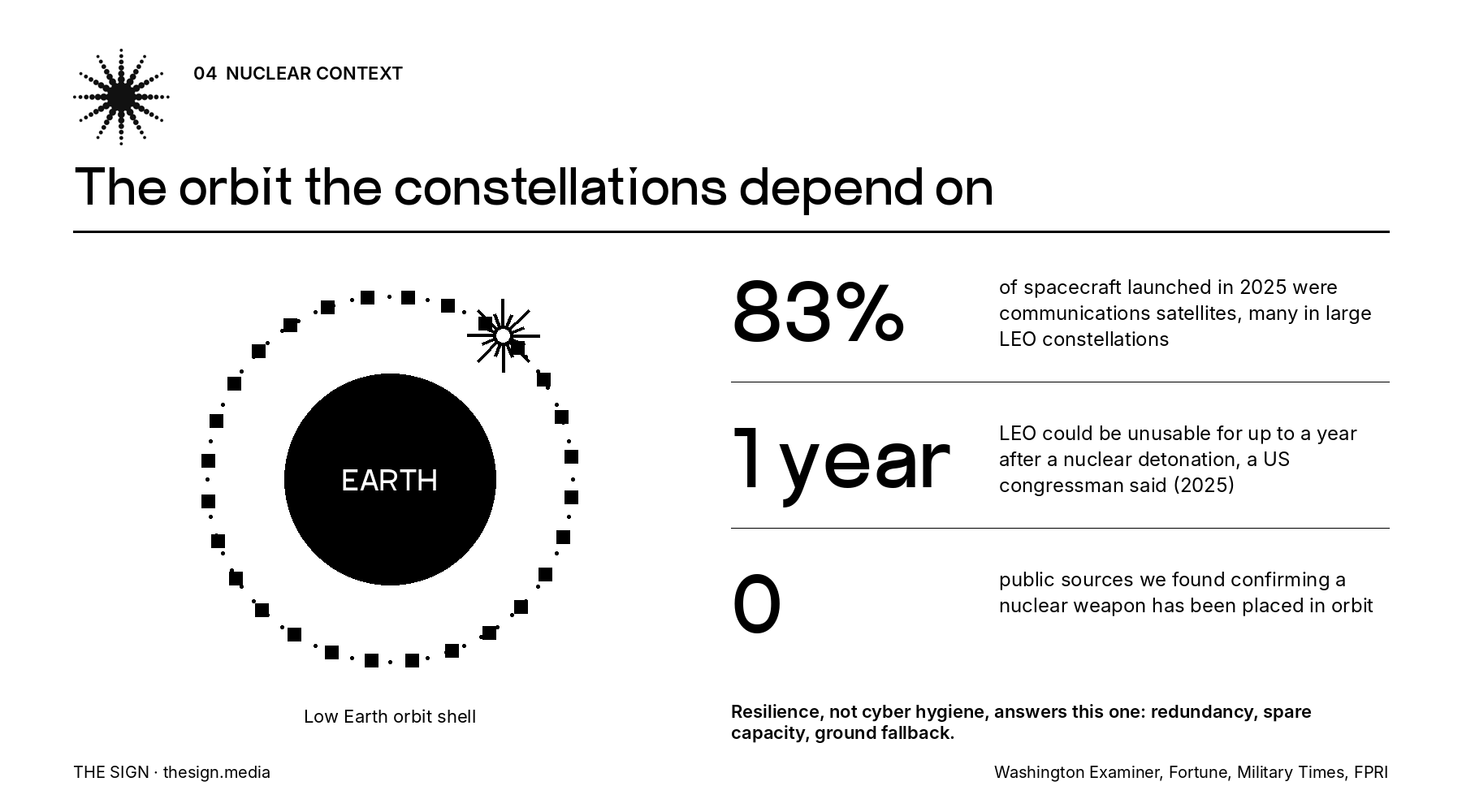
The forecast growth in satellite numbers assumes a usable low Earth orbit, and that is the assumption a nuclear anti-satellite weapon would break.
In April 2026 the head of US Space Command said Russia is thinking about placing such a weapon in orbit. A detonation in low Earth orbit would hit thousands of civilian satellites and disrupt satellite communications and GPS (Washington Examiner). In 2025, US officials described the weapon as not yet ready for deployment, and a congressman said it could make low Earth orbit unusable for satellites for up to a year (Fortune).
A September 2026 report found the US not prepared to respond. Its workshop scenarios included a nuclear detonation in low Earth orbit and in geostationary orbit, and strategists found no existing capability to recover from either (Military Times). An August 2026 analysis argues that Russia's anti-satellite investment is meant to keep its nuclear deterrent credible, and that US missile defence spending has encouraged nuclear-armed options against large constellations, including private ones (FPRI). No public source we found confirms that a nuclear weapon has been placed in orbit.
How this connects to the numbers (our reading): 83% of the spacecraft launched in 2025 were communications satellites, many of them in large low Earth orbit constellations, so a single event there would hit commercial fleets at once. It is also the one scenario where better cyber hygiene does not help. Resilience does: redundancy, spare capacity and ground fallback.
5. What to watch: Bureau 1440
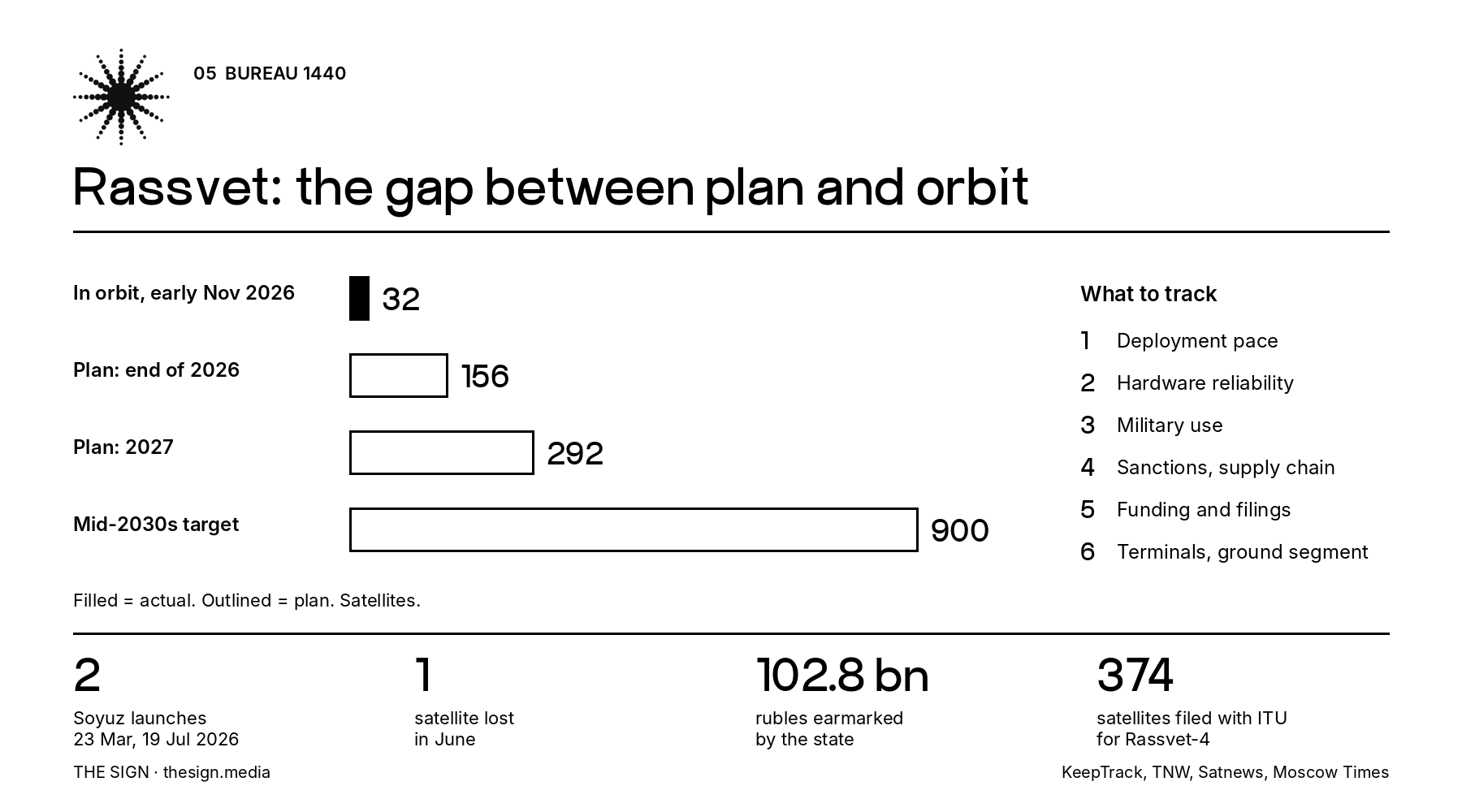
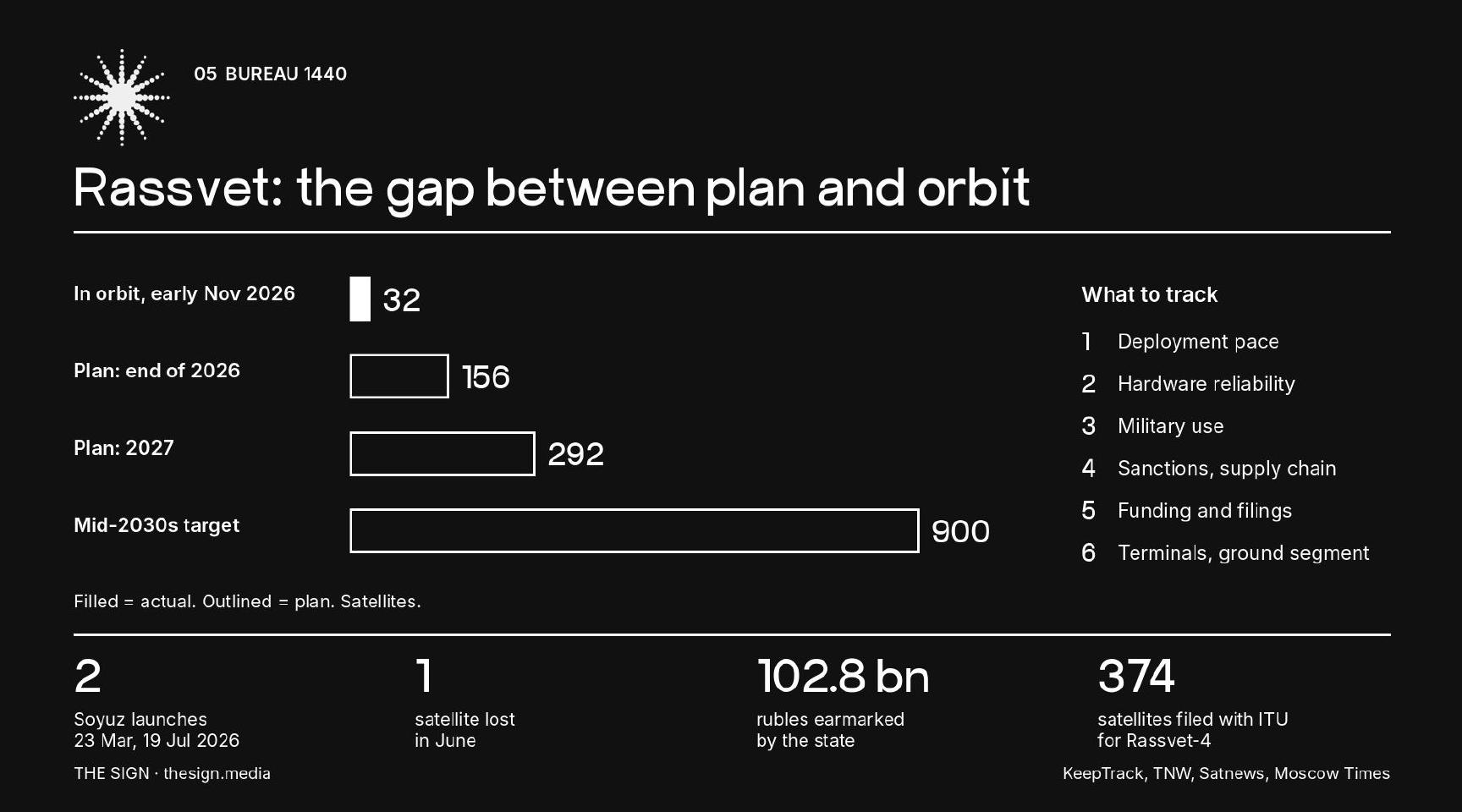
Bureau 1440 is a Russian company created in 2020 from a MegaFon research lab and now part of IKS Holding (El Español). It builds Rassvet, a low Earth orbit constellation presented as a Russian alternative to Starlink, with 5G non-terrestrial network links and inter-satellite lasers (Janes). It has launched 32 production satellites on two Soyuz missions, on 23 March and 19 July 2026 (Satnews). Six things to track:
- Deployment pace against the roadmap. A roadmap summarised in July calls for 156 satellites in orbit by the end of 2026 and 292 in 2027, with partial service from 2027 (KeepTrack). Against 32 launched by early November, the gap is the first signal. The longer-term target is about 900 by the mid-2030s (TNW), about 2% of the more than 43,000 satellites Novaspace expects to launch by 2035 (our arithmetic).
- Hardware reliability. One satellite was lost in June (Meduza), and Satnews reports hardware degradation in orbit on the early batches. The next batches will show whether it is fixed.
- Military use. Ukraine's defence intelligence said Russian forces used Rassvet satellites for several hours (Janes). On 30 October Ukraine sanctioned Bureau 1440 and affiliated companies, saying the network could give Russian forces their own link to control drones and missiles over long distances (Kyiv Independent). These are Ukrainian assessments, not independently confirmed.
- Sanctions and supply chain. Ukraine and its partners are exploring sanctions and trade restrictions on Bureau 1440, its subsidiaries and Chinese companies (Atlantic Council). Whether Western measures follow will shape how fast Rassvet can scale.
- Funding and filings. The state has earmarked 102.8 billion rubles, and the company plans 329 billion rubles of its own funds through 2030 (Moscow Times). In early November Russia filed with the ITU for a further 374-satellite constellation, Rassvet-4 (Satnews).
- Terminals and ground segment. Bureau 1440 has unveiled three subscriber terminals (Militarnyi), and one analysis argues that its ground stations and control centres may be an easier target than jamming the terminals (Tech Times). For cyber defenders, that is where the attack surface sits (our reading).
How this connects to the nuclear context: we found no source linking Rassvet to nuclear command and control. The link is indirect. Both are Russian space programmes whose exposure depends on the same orbital shells, and Rassvet launches from Plesetsk, a military site that also serves to test land-based nuclear missiles (Defence Blog).
6. More to watch into 2027
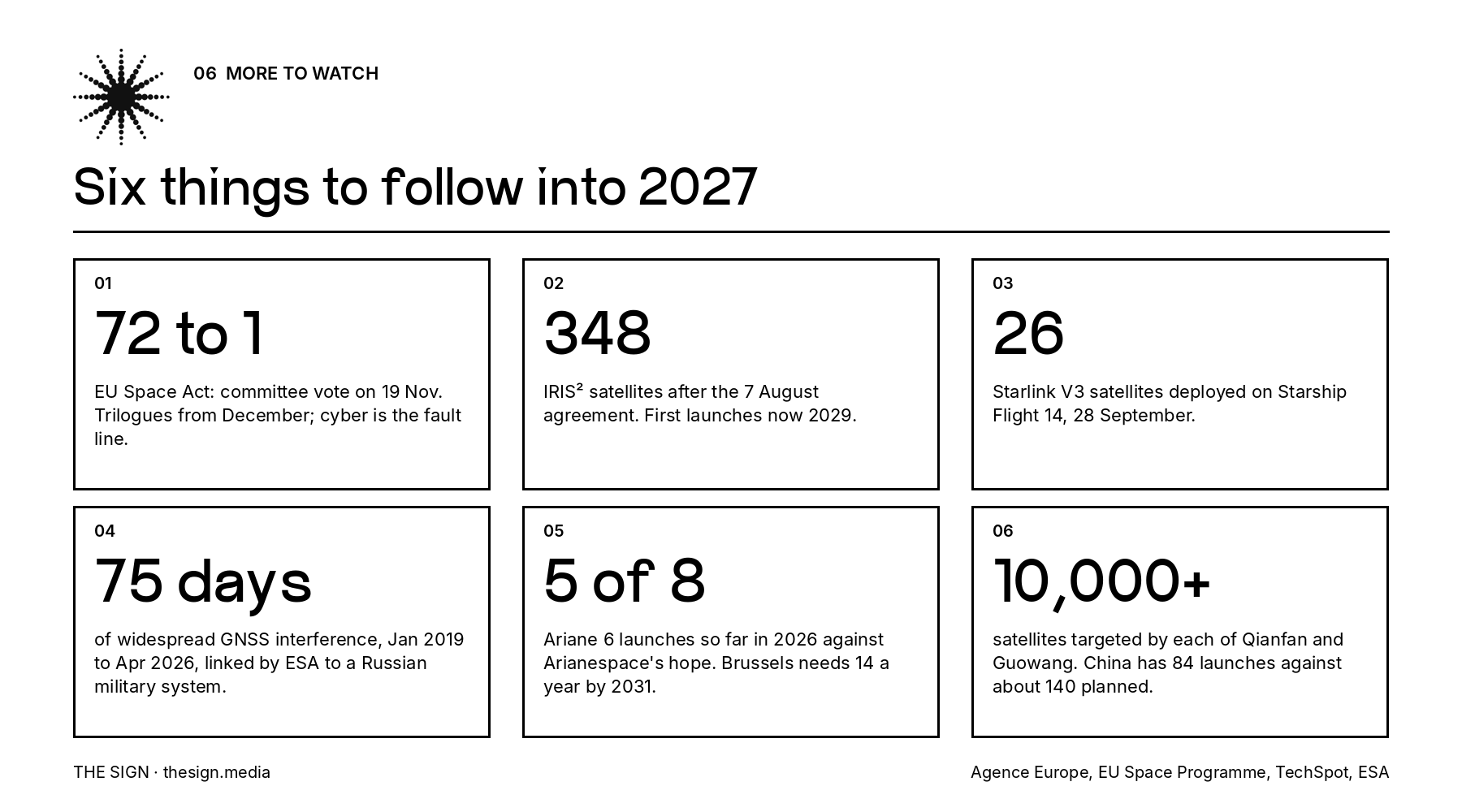
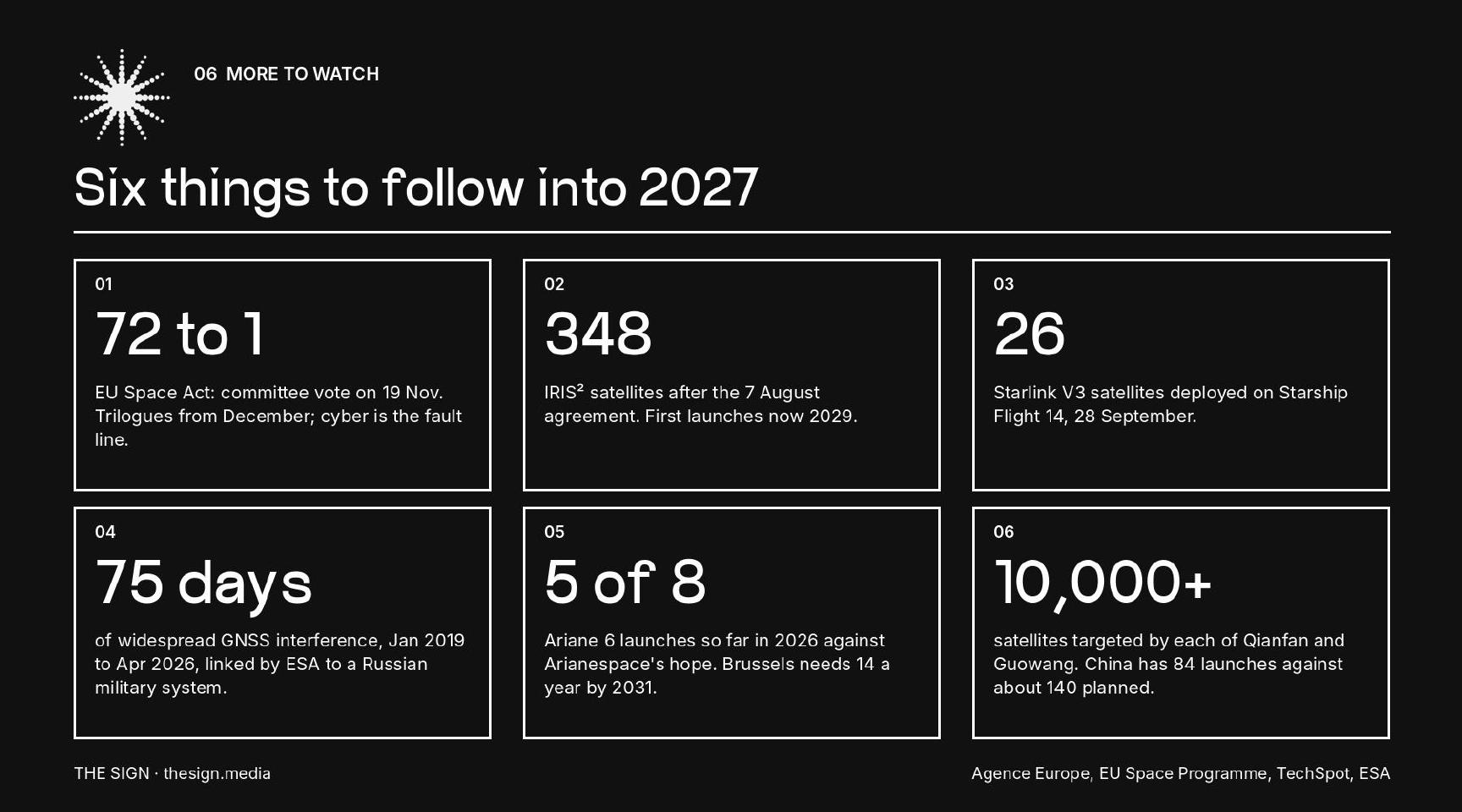
- EU Space Act trilogues. Parliament's industry committee adopted its position on 19 November, by 72 votes to 1 (Agence Europe). Trilogues with the Council could open as early as December, but every delegation in the Council still holds scrutiny reservations (The European Post). Cybersecurity is the fault line: the Commission wants the Act to be the specific law for cyber risk, while an October analysis reported that Parliament deletes that chapter and brings space under NIS2 (The European Post). ENISA's 2026 NIS360 report rates space as highly critical, with cyber maturity stuck (CYSAT).
- IRIS² delivery. The 7 August implementation agreement expanded the constellation to 348 satellites and brought first launches forward to 2029, with sovereign, accredited services from 2030 (EU Space Programme). The open points are whether the schedule holds and how the new defence layer is secured (our reading).
- Starship and Starlink V3. Flight 14 on 28 September was Starship's first orbital flight and deployed 26 Starlink V3 satellites, which are too large for Falcon 9 (TechSpot). An engine failure ended the mission early (Reuters via Emirates 24/7). The open question is how fast V3 deployment ramps, since it would concentrate even more capacity with one operator (our reading).
- GNSS interference from orbit. UT Austin researchers found 75 days with widespread GNSS interference between January 2019 and April 2026 (Ars Technica via Harvard). ESA says the events were traced to a Russian military satellite system, and notes that satellite navigation enables 10% of European GDP (ESA). One report names Kosmos 2546, part of Russia's missile launch detection constellation (CyberWire). New events and the detection tools ESA is funding are the things to follow.
- Ariane 6 cadence. Arianespace hoped for eight Ariane 6 launches in 2026 (Agence Europe). ESA and CNES records show five flights so far, on 12 February, 30 April, 17 June, 27 August and 24 November (our count, from ESA and CNES). Brussels says it will need 14 a year by 2031, so this gap is the practical test of European access to orbit.
- Chinese constellations. Qianfan and Guowang both aim for more than 10,000 satellites (ISS Tracker), yet China's 84 launches so far trail its reported target of about 140 (CislunarSpace). The test is whether the cadence recovers in 2027.
Launch calendar: December 2026 – 2027
A selection of planned launches, as listed on 26 November 2026 by Padside, Next Liftoff, European Spaceflight and Arianespace. NET means no earlier than; dates move often. The cybersecurity column is our reading.
- 2 DecSpaceX for the US National Reconnaissance OfficeNROL-132 (Falcon 9)A classified payload: no public data on function or orbit, which is the reporting gap described in section 3.
- 10 DecCASC for China SatNetSatNet LEO group (Long March 12), to be confirmedAnother Guowang batch. Each one adds to a state-run constellation whose security baseline is not public.
- 17 DecArianespace for ESA and EUMETSATMetop-SG B1 (Ariane 62, flight VA272)Weather data feeds aviation, shipping and defence planning, so the integrity of the downlink and ground segment matters more than the satellite count.
- NET DecSpaceX for AmazonAmazon Leo LF-04 (Falcon 9)A second large broadband fleet built in series: one flaw in a shared design repeats across every satellite.
- NET DecSpaceX for EutelsatOneWeb #21 (Falcon 9)Europe's operating LEO constellation is replenished on a US launcher, a dependency in the supply chain as well as in access to orbit.
- 10 JanMitsubishi Heavy Industries for the Government of JapanIGS Optical Diversification 1 (H3)A reconnaissance satellite: tasking and imagery links are high-value targets for interception and interference.
- 22 JanSpace One for the Japan Self-Defense ForcesJSDF SDA demonstration satellite (Kairos)Space domain awareness from orbit. More sensors mean more shared tracking data, which defenders rely on.
- NET JanSpaceX for the US Space Development AgencyTranche 2 Transport Layer C and F (Falcon 9)A military mesh network in LEO moves the perimeter to orbit: every satellite and every inter-satellite link is a node to defend.
- NET FebArianespace for the European Commission and ESAGalileo L15 (Ariane 62)More Galileo satellites strengthen a navigation service that can authenticate its signal, the direct answer to the spoofing discussed in section 6.
- NET FebSpaceX for the Italian Ministry of DefenceSICRAL 3A (Falcon 9)Protected military satcom. The ground segment and user terminals stay the likely targets.
- NET FebSpaceX rideshareTransporter 19 (Falcon 9)Dozens of small commercial satellites in one launch, many built to tight budgets with little protection on the command link.
- NET AprAvio for KARI and ASIKOMPSAT-6 and PLATiNO-1 (Vega C)Radar imaging for two governments on a European launcher: sovereign access to orbit in practice.
- NET JunSpaceX rideshareTransporter 20 (Falcon 9)The same pattern as Transporter 19: many operators, uneven security, one shared ride.
- NET NovSpaceX for the Italian Ministry of DefenceSICRAL 3B (Falcon 9)Completes the pair. A two-satellite system gives redundancy, and also two copies of the same design to protect.
- NET H1PLD SpaceMiura 5 maiden flight (Kourou)A Spanish launcher adds a European route to orbit. A new vehicle also brings new flight software and a new supply chain to secure.
- NET Q3SpaceX for TelesatTelesat Lightspeed 1 (Falcon 9)First launch of a new LEO broadband constellation aimed at enterprise and government users, so the security baseline is set at the start.
- To be confirmedAvio for SES, ESA and the European CommissionEAGLE-1 (Vega C)Europe's first quantum key distribution satellite: a test of key exchange from orbit that resists interception.
- To be confirmedArianespace for AmazonAmazon Leo LE-05 to LE-07 (Ariane 64)The heaviest use of Ariane 6 is for a US constellation, which ties European launch cadence to a foreign operator's schedule.
7. Conclusion
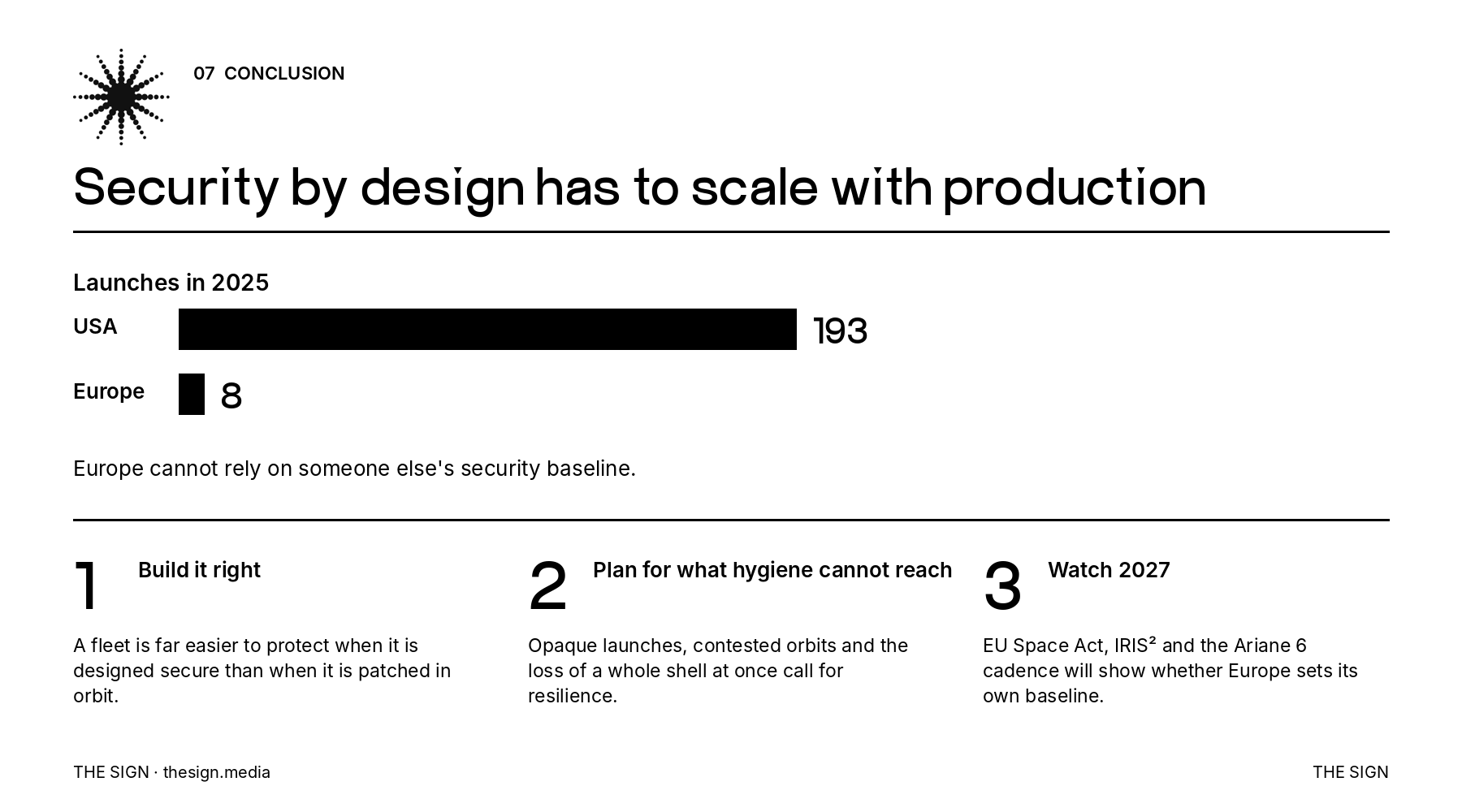
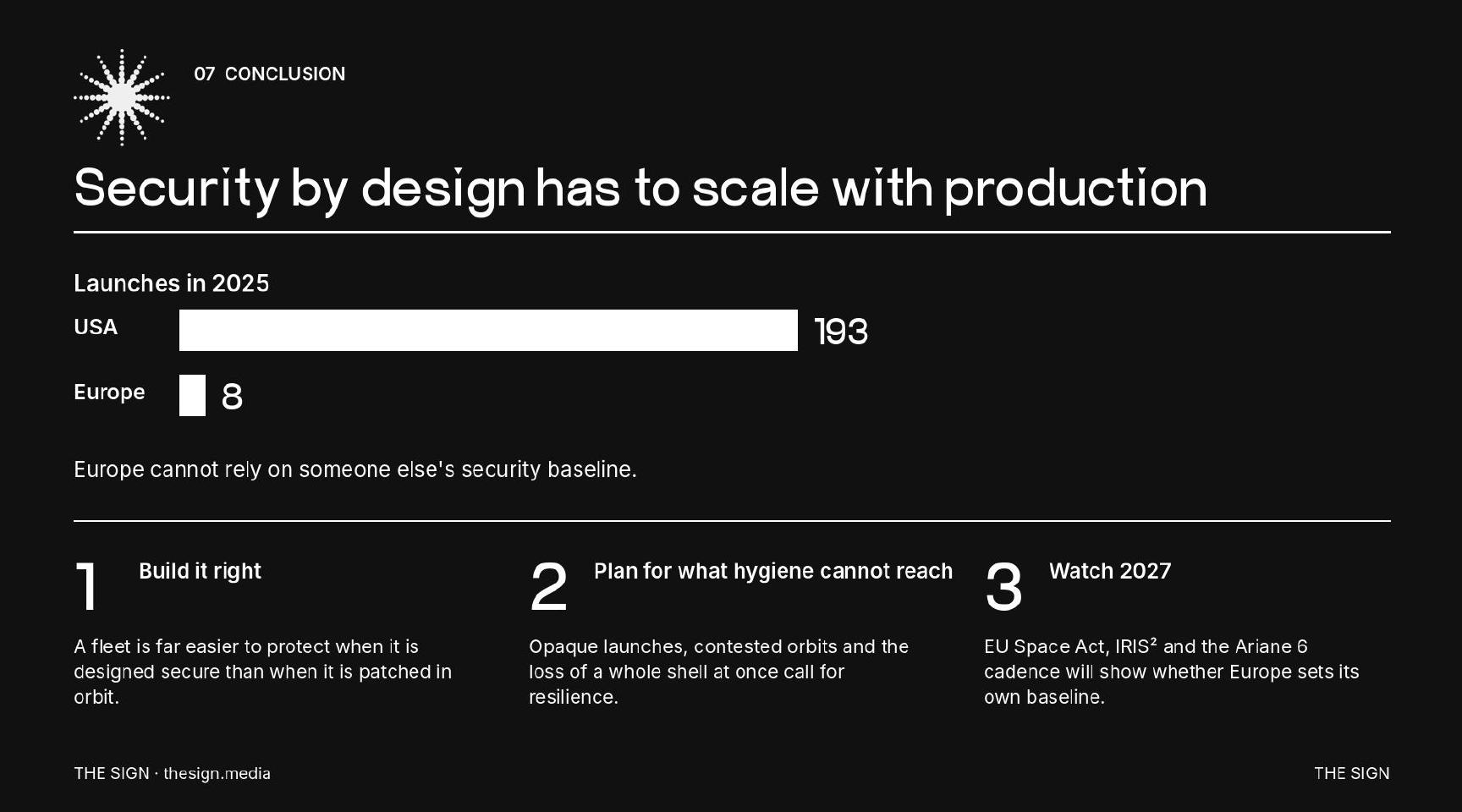
Space is getting busier, and the security work has not kept pace. Launch totals flattened in 2026, but the satellites keep multiplying, concentrated in a few fleets, built on standard platforms and launched by a handful of providers. That is where one flaw becomes thousands of problems.
Two things follow. Security by design has to scale with production, because a fleet is far easier to protect when it is built right than when it is patched in orbit. And resilience has to cover what cyber hygiene cannot reach: opaque launches, contested orbits and the risk of losing a whole shell at once. Europe launched 8 times in 2025. Europe's supply chains cannot rely on someone else's security baseline. In 2027 the EU Space Act, IRIS² and the Ariane 6 cadence will show whether it means to set its own.
Author: Tatiana Skydan, Co-founder and editor-in-chief, THE SIGN
Caveats
- Launch counts depend on method. SpaceNews counts 324 attempts. Jonathan McDowell's tally is 329, with the US at 181 and China at 92 (Jonathan's Space Pages), while BryceTech counts 193 US launches.
- 2026 figures cover part of the year and trackers differ. FlightAtlas counts 277 attempts by 26 November, Orbital Radar 279 (Orbital Radar) and Wikipedia 269 by 20 November (Wikipedia). FlightAtlas also puts 2025 at 329 launches, against the 324 used above.
- The 2035 figure is a Novaspace forecast and gets revised: an earlier edition projected 36,900 satellites from 2024 to 2033 (Novaspace).
- The reporting that Russia will stop giving the UN information on defence launches comes from one source and carries no date.
- Distances in the ICEYE case differ by source: about 500 metres (LeoLabs), 26 metres (one tracker, unconfirmed) and 1 to 2 kilometres in earlier readings. A Polish claim that Russia leased an ICEYE satellite to watch NATO ships is unverified and is not used here.
- Treat any single launch count as one tracker's view, and cross-check it before it goes into a headline.
Sources
- Launch statistics 2025: SpaceNews analysis, BryceTech, Global Orbital Launches 2025, European Space Agency report via gasworld.
- Data for 2026: FlightAtlas, Orbital Radar, GCN, ISS Tracker, CNES, European Spaceflight, Satnews.
- Russian launches: United24 Media, Prensa Latina, KeepTrack, Interfax.
- Proximity case (ICEYE-X36): RUSI, Breaking Defense, Tech Times, Al Jazeera.
- Forecast: Novaspace, Satellites to Be Built and Launched, 28th edition.
- Launches without notice: UN registration data, UN document ST/SG/SER.E/1237, RussianSpaceWeb, Space.com, Bloomberg via BNN, Korea Herald via Asia News Network, NBC New York.
- Nuclear context: Washington Examiner, Fortune, Military Times, FPRI.
- Bureau 1440 and Rassvet: Moscow Times, Janes, Satnews, TNW, Meduza, El Español, KeepTrack, Kyiv Independent, Atlantic Council, Militarnyi, Tech Times, Defence Blog.
- Policy, navigation and launch capacity 2026: Agence Europe on the Space Act, The European Post, CYSAT on ENISA NIS360, EU Space Programme on IRIS², TechSpot on Starship, Ars Technica via Harvard, ESA on GNSS interference, Agence Europe on Ariane 6.