
Accelerating satellite signal acquisition with ARM's SME2: Ukraine battlefield command-and-control implications
The war in Ukraine has demonstrated the importance of distributed and mobile command-and-control capabilities, resilient communications under electronic warfare conditions, rapid deployment of relatively inexpensive unmanned systems, integration of satellite communications with terrestrial radio networks, and maintaining connectivity despite infrastructure damage and geographical separation. Against this background, several possible applications of ARM's SME2 deserve attention. Read an analysis by Christophe Bosquillon.

ARM twisting
ARM (short for Advanced RISC Machine, originally Acorn RISC Machine) is a Reduced Instruction Set Computer (RISC) processor architecture widely used in mobile devices and wireless communications hardware. Designed by Arm Holdings, it uses simplified instructions to deliver high performance per watt with low power draw and minimal heat. ARM's impacts in mobile communications include system-on-Chip (SoC) Cores (ARM cores serve as the main CPU inside smartphone and mobile device SoCs, paired with GPUs, NPUs, and cellular modems) and battery efficiency (streamlined RISC instructions suit battery-powered, fanless mobile hardware that operates under strict thermal and power limits). ARM Holdings licenses its architecture and core designs to chipmakers such as Apple, Qualcomm, Samsung, and MediaTek, rather than manufacturing chips itself
In an ARM blog post (10 November 2026), Professor Sylvester Kaczmarek describes an open-source, ground-side prototype satellite communications (satcom) signal-processing system that uses ARM's Scalable Matrix Extension 2 (SME2) technology to accelerate satellite signal acquisition. Its purpose is to demonstrate how relatively inexpensive, phone-class computing hardware, combined with a software-defined radio (SDR), could provide portable, rapid and reliable satellite communications monitoring and testing in the field. The tool is a developer and test aid, not an operational flight or military system, and the blog doesn't cover defense applications. Nonetheless, battlefield communications and command and control immediately come to mind, and a review is warranted of which practical applications this solution could lead to.
Professor Sylvester Kaczmarek's ARM blog post is titled 'Accelerating digital signal processing with Arm SME2 for satellite signal acquisition - See how Arm SME2 speeds up satellite signal acquisition with a portable satcom workflow, synthetic IQ replay, and diagnostics to assess decoding confidence.' This open source project is publicly available on GitHub, including the source code, synthetic IQ datasets, benchmark tools, correctness tests and an Android NDK benchmarking path: Pocket Satcom Acquisition and Trust Lab -- GitHub.
Underlying problem
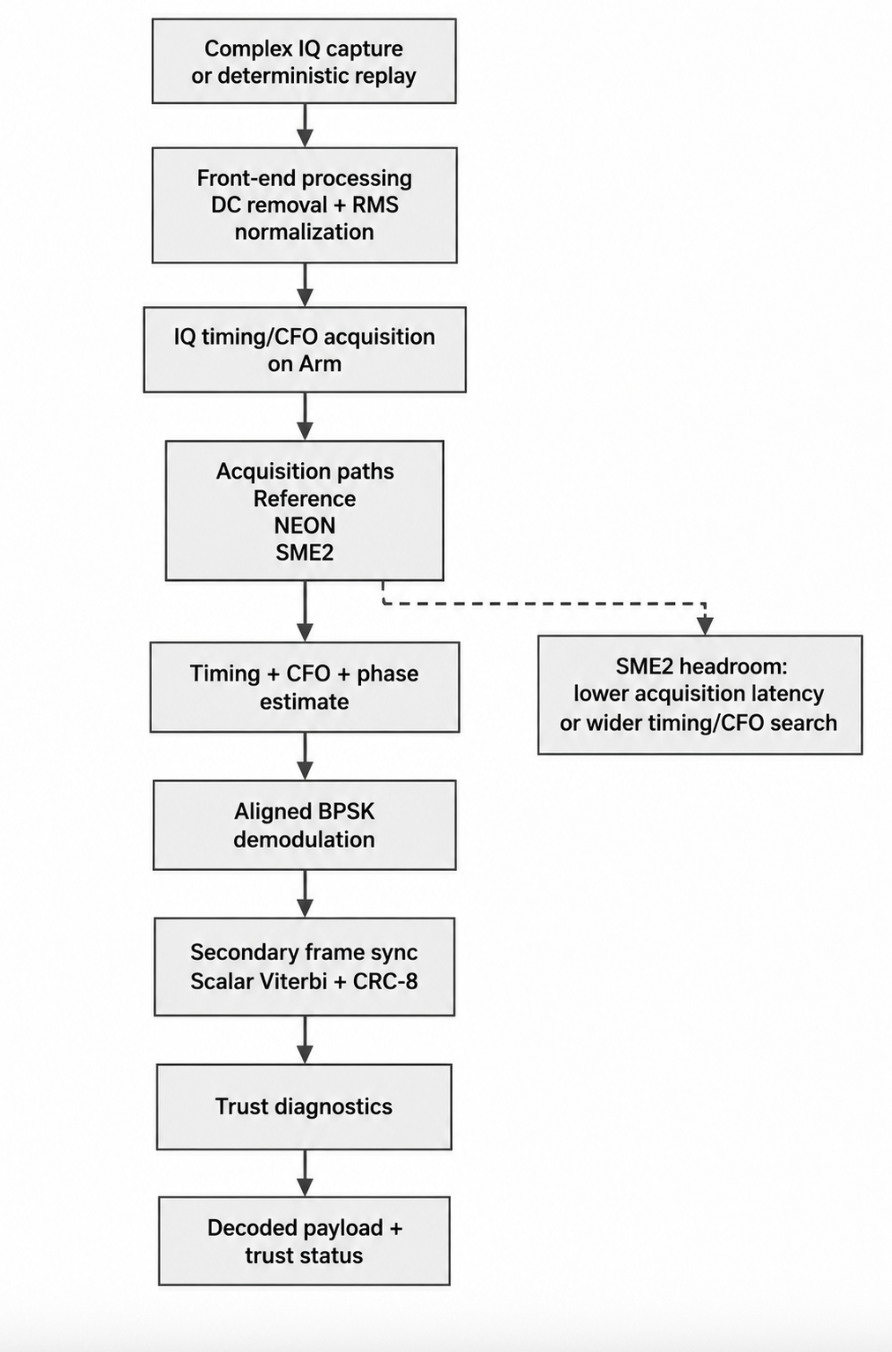
Satellite receivers do not receive ready-to-use digital information. They receive radio signals represented as complex in-phase / quadrature (IQ) samples, which must be processed through several stages before usable information can be recovered. These include detecting the signal and establishing its timing; compensating for frequency shifts, particularly those caused by the Doppler effect resulting from relative satellite-ground movement; demodulating the signal to recover digital information; synchronising and decoding the transmitted data; and checking data integrity and assessing whether the result can be trusted.
ARM SME2's innovative solution
The proposed innovative solution uses ARM SME2 to accelerate the most computationally demanding part of this process: signal acquisition. This involves searching across numerous possible timing offsets and carrier-frequency offsets (CFOs) to identify the correct signal. SME2 allows multiple candidate calculations to be processed in parallel, reducing the time required to identify and lock onto a signal.
The implementation compares three approaches: scalar processing (conventional sequential calculations, used as the reference for correctness); ARM NEON (an established SIMD (Single Instruction, Multiple Data) technology that processes multiple data elements in parallel); and ARM SME2 (a newer architecture that provides more extensive vector-processing capabilities and specialised matrix-oriented hardware resources).
Operational significance of the performance improvement
As per results reported in the blog post, SME2 consistently outperformed NEON across all tested workloads on both platforms. The figures represent the reported measurements; speed improvements are approximate ratios of the displayed median timings. The five-run variation is reported separately for the M5 Pro and vivo X300 results.
The additional processing capacity can be used in two ways: it reduces the time needed to acquire and identify a satellite signal, and it searches a wider range of possible signal timings and frequencies within the same time budget. This second option is particularly relevant when Doppler shifts, oscillator inaccuracies, interference or uncertain satellite positioning make signal acquisition more difficult.
An acquisition speedup for which effects?
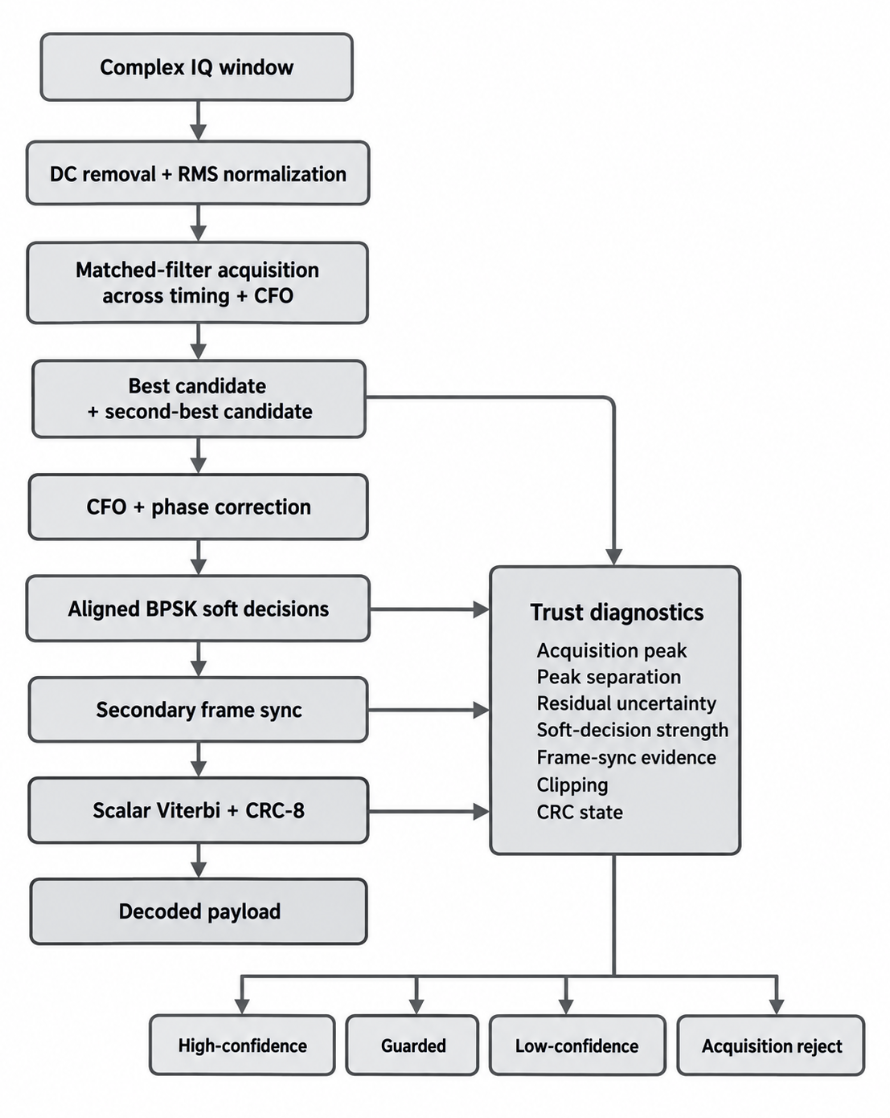
The speedup can buy either a faster result or a wider timing/frequency search within the same latency budget. The speedup also has an effect on trust diagnostics: the system reports an inspectable score and status band, not just a payload. Inputs are peak strength, peak separation, soft-decision quality, frame-sync evidence, clipping and CRC state. "Healthy", "impaired", "ambiguous", "CRC-failed" and "no-signal" are explicit outcomes. The scores are engineering heuristics, not calibrated probabilities.
The solution is worth testing for next steps: data is synthetic, with no live-RF path and no real waveform. Power and thermal behavior are unmeasured. Planned work includes live SDR input, tracking, more modulation and coding schemes, and calibrated diagnostics. FFT or hierarchical search may beat brute force for much wider searches.
How that would work on the battlefield
This solution is an enabling building block for smaller, cheaper and more distributed satcom processing, not an immediately deployable drone-control capability. Its relevance to satellite-to-drone command in Ukraine is real but indirect, so let's not jump too hastily to conclusions yet. But this solution could change quite a few significant parameters.
This solution enables reacquisition and wider search: faster or wider acquisition shortens outages after interruptions and tolerates more drift. This helps with Doppler, oscillator error and movement, although it does not defeat deliberate jamming.
Portable diagnostics become workable: a phone plus SDR can tell field teams whether a link failure is RF or acquisition related, or a software fault.
Link-state reporting becomes explicit: machine-readable "ambiguous / failed / no signal" states let operators or autonomy decide whether to act, hold or fall back.
A better architecture for drones command: satellite-connected relay nodes feeding UAVs over local radio may be more practical than a terminal on every drone. Autonomous flight control should stay onboard, with satellite links used for supervision, telemetry and mission updates.
Next practical steps
Potential future development could include integration of live SDR signal reception, more sophisticated timing and frequency tracking, support for additional modulation and error-correction schemes, testing of power consumption, thermal behaviour and energy efficiency, and better calibration of signal-confidence diagnostics using real-world radio-frequency conditions.
Developers could go for demos by treating this solution as a prototyping and test accelerator. Test it on representative waveforms once live SDR input matures. Measure end-to-end time to first usable frame, plus power and thermal behavior. Expose acquisition and trust status as a queryable "link health" service for command-and-control software. Judge the prototype architecture on the whole link: size, weight and power, latency, jam resistance, authentication and supplier dependence.
While the blog technical content, benchmark numbers, and limits warrant well-informed initial testing, synthetic data, the missing live-RF path, and unmeasured power and thermal behavior prevent any operational claim yet. Demos should clarify specifically each of these aspects.
The role that SME2 plays is limited to acquisition and that includes a trade-off between speed and search width. The introduction of a trust layer has the merit of clarifying the explicit ambiguity and failure states, knowing the score is a heuristic, not a probability.
The gains from this solution are real, but play a role as one component among several. Further, diagnostics do not authenticate commands: signal quality is not authenticity, and spoofing or replay protection requires cryptography and anti-spoofing measures.
How about drones? These results are significant for contested theaters and intuitively would imply a reasonably direct benefit for satellite-to-drone command. However, for drones, acquisition is rarely the binding constraint, and production terminals use dedicated silicon or FPGAs, while drones will not carry SME2-class processors anytime soon. Prototyping this solution for drones is worth trying though, at least as a demo benchmark.
Tactical benefits
Speeding up acquisition is a performance gain with some tactical benefits. But the real significance could be decentralization of satcom capability through lower size and cost, if other binding constraints can be managed.
Enabling a wider search somehow helps against "partial jamming". However that shouldn't be confused with anti-jamming. Reacquisition after interruption and a wider search can plausibly help recover a signal that has drifted, but tests weren't conceived to measure resilience to deliberate interference, so caution is warranted.
It could be argued that Starlink/Starshield terminals already do this work. Under current circumstances though, it matters to pay attention to solutions outside a Starlink architecture, which its owner has deliberately disrupted and restricted several times over Ukraine, making its use unreliable, and costing casualties on the battlefield.
Distinguishing capabilities for military use
The above empiric drill-down warrants to separate acquisition, communications and command-and-control, distinguishing satellite-connected ground control from satellite-connected relay. In particular, direct satellite links may not suit real-time flight control in the case of drones, however drones do require proper investigation, coming up in the next section.
The most important aspect of this development may arguably not be the approximately twofold processing improvement itself, but rather what it makes possible in terms of the size, cost and distribution of satellite communications capabilities.
Historically, reliable satellite signal acquisition and analysis have often required specialised receivers, dedicated processing hardware or relatively powerful computers. This demonstration points towards a different model: compact, relatively inexpensive computing devices capable of performing increasingly sophisticated satellite communications processing.
For military applications, this could contribute to the decentralisation of satellite communications capabilities, making them more accessible to individual units, mobile command posts, unmanned systems and field technicians.
It is important, however, to distinguish between three different capabilities: satellite signal acquisition (finding and establishing a usable connection to a satellite); satellite communications (exchanging information through an established communications link); and satellite command and control (using that link to transmit instructions to remote systems, including unmanned aerial vehicles -- UAVs aka (flying) drones).
This ARM SME2 solution demonstrates progress primarily in the first capability. It provides a potential technological building block for the other two, rather than demonstrating them directly.
Direct command and control of drones through satellites
One particularly interesting potential application is the use of satellite communications to provide command-and-control connectivity to UAVs operating beyond the range of conventional radio links.
In a conventional UAV operating environment, communications often depend on direct radio-frequency connections between the aircraft and its ground control station. These connections can be constrained by terrain, distance, line of sight and the availability of relay infrastructure. Satellite communications can overcome some of these limitations by providing a communications path between geographically separated platforms.
The relevance of the ARM development is that faster and more efficient signal acquisition could eventually help make the associated ground-side communications equipment smaller, less expensive and more flexible.
Potential applications include:
- Beyond-line-of-sight (BLOS) communications: maintaining communications with UAVs operating beyond the direct radio horizon of their operators.
- Distributed command posts: providing mobile units with compact satellite communications equipment rather than relying exclusively on larger fixed or vehicle-mounted terminals.
- UAV fleet management: supporting communications between remote operators and multiple unmanned platforms through satellite networks.
- Communications redundancy: providing an alternative communications path when terrestrial networks, conventional radio links or local relay infrastructure become unavailable; and
- Remote mission supervision: allowing operators to receive telemetry, status reports and other information from UAVs operating at considerable distances.
However, faster signal acquisition alone does not solve the fundamental challenges of satellite-controlled UAV operations. These include available bandwidth, communications latency, antenna tracking, link availability, encryption, resistance to jamming and the reliability of the satellite infrastructure itself.
*In particular, satellite links should not automatically be considered suitable for real-time flight control. The achievable latency and reliability depend heavily on the satellite constellation, orbit, network architecture and communications terminal.
Potential relevance to Ukraine
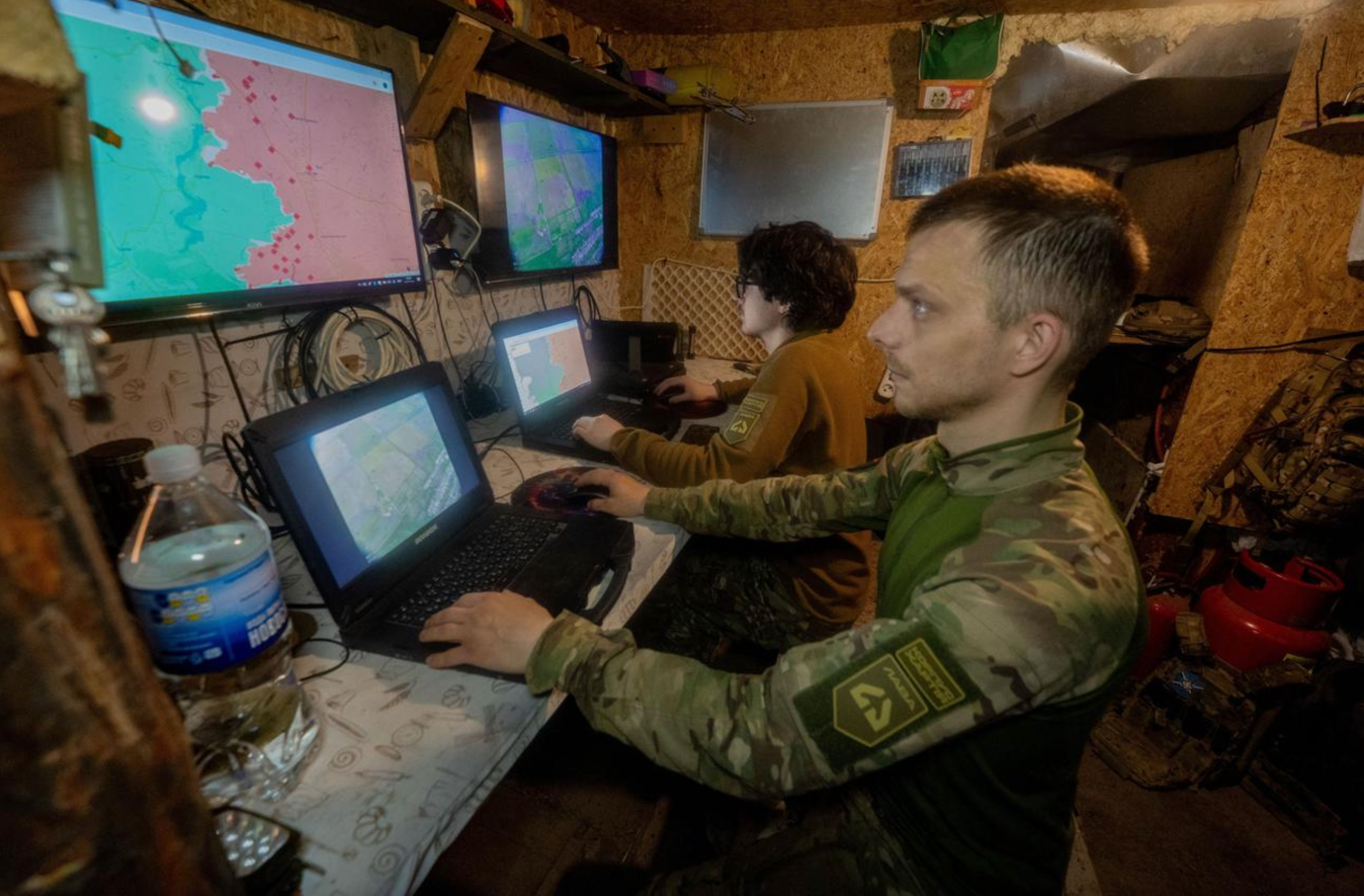
The war in Ukraine provides a particularly relevant environment in which to consider the potential implications of this solution. The conflict has demonstrated the importance of distributed and mobile command-and-control capabilities, resilient communications under electronic warfare conditions, rapid deployment of relatively inexpensive unmanned systems, integration of satellite communications with terrestrial radio networks, and maintaining connectivity despite infrastructure damage and geographical separation. Against this background, several possible applications deserve attention.
1. More accessible satellite communications terminals: compact satellite receiver technology could make it easier to equip smaller military units with satellite communications monitoring and diagnostic capabilities. This could be valuable for identifying communications problems, verifying link availability and assessing signal quality without depending on specialised technical teams.
2. Improved communications resilience: the ability to search a wider range of possible signal frequencies and timing offsets could help receivers cope with uncertainty caused by Doppler shifts, oscillator inaccuracies and changing radio conditions. However, this should not be confused with anti-jamming capability. A faster receiver may be able to search more efficiently, but it does not inherently overcome deliberate interference, frequency denial or sophisticated electronic attacks.
3. More flexible UAV communications architecture: a compact satellite communications terminal could potentially become part of a distributed UAV command-and-control architecture. For example, a remote operator could communicate through a satellite network with a command node that subsequently relays instructions to UAVs over local radio links. This would not necessarily require every UAV to carry its own satellite terminal. In many circumstances, a satellite-connected ground or airborne relay could be a more practical architecture.
4. Greater independence from fixed communications infrastructure: portable satellite communications equipment could help maintain connectivity when conventional telecommunications infrastructure is unavailable, damaged or unreliable. This is particularly relevant to mobile command posts and units operating in areas where terrestrial communications infrastructure has been disrupted.
An important distinction: satellite connectivity versus direct satellite control
Regarding direct control of drones through satellites, there are two fundamentally different architectures:
Satellite-connected ground control means an operator communicates with a remote UAV through a satellite network. Instead, satellite-connected relay means that a ground or airborne command node communicates with UAVs through local radio links, while receiving connectivity through satellite.
For ground control, the satellite provides the communications link between operator and aircraft. For relay, what matters is that it allows multiple UAVs to use a shared satellite-connected communications node. Both architectures are technically feasible, subject to the communications infrastructure and operational constraints.
The Arm SME2 development could contribute to the ground-side processing capabilities needed for such systems, but it does not itself provide the satellite modem, antenna, network access, encryption or UAV control software.
There is also an important distinction between transmitting high-level mission instructions and continuously controlling an aircraft's flight surfaces or navigation. For safety and resilience, autonomous flight-control functions should remain onboard the UAV. Satellite communications are better suited to mission updates, supervision, telemetry and other functions that can tolerate intermittent connectivity and variable latency.
Electronic warfare and contested communications environments
An important consideration for Ukraine is the relationship between this solution and electronic warfare.
The solution's emphasis on signal acquisition quality and trust diagnostics is relevant because simply receiving and decoding a signal does not necessarily mean that the receiver has correctly identified the intended transmission or that the resulting data is reliable. The ability to identify weak or ambiguous signal acquisition, unexpected frequency offsets, poor synchronisation, data corruption, and no-signal conditions could improve the ability of field personnel and communications systems to recognise degraded links.
Nevertheless, the prototype does not demonstrate operation under deliberate jamming, spoofing or sophisticated electronic attack. Its confidence score is an engineering diagnostic, not a calibrated probability that a signal is authentic or secure. Military implementations would need substantially more extensive testing, including authentication, cryptographic integrity, anti-spoofing measures and resilience against electronic interference.
Conclusion
The most realistic near-term implication may not be the immediate introduction of satellite-controlled drones based on this solution. Rather, it is the gradual integration of more powerful, compact and inexpensive signal-processing capabilities into distributed military communications equipment.
The ARM SME2 demonstration is a relatively modest development in terms of what it actually implements, but potentially quite significant in terms of its wider technological implications.
Its principal contribution is demonstrating that sophisticated satellite signal acquisition can be accelerated substantially using relatively accessible, mobile-class processing hardware. For military applications, the longer-term significance lies in the potential to make satellite communications processing more portable, affordable and widely distributed.
For Ukraine, the most interesting potential application is the integration of compact satellite communications capabilities into distributed UAV command-and-control networks and mobile military command infrastructure. This could contribute to maintaining communications with unmanned systems operating beyond conventional radio range and provide additional connectivity when terrestrial infrastructure is disrupted.
However, three important technological steps remain before the article's demonstration can be translated into an operational military capability:
- Integration with live satellite radio-frequency signals and actual satellite communications waveforms.
- Demonstration of reliable operation under contested electromagnetic conditions.
- Integration into complete communications systems, including antennas, modems, networking, encryption and command-and-control software.
This solution is worth monitoring as an enabling technology rather than as an immediately deployable military device. Its importance is less about making existing satellite communications twice as fast and more about potentially making capable satellite communications equipment smaller, cheaper and easier to distribute across the battlefield.
This solution could have meaningful implications for the future architecture of military communications, particularly the increasingly interconnected relationship between satellites, mobile command posts, autonomous systems and UAV operations. This alone justifies continuing testing and developing it.
Author: Christophe Bosquillon MSc, MBA, Founder & Director, Senior Fellow, NIDS - National Institute for Deterrence Studies (U.S.), Fellow, EIPIO – European Institute of Professional Intelligence Officers